Why Bathroom Fans Fail to Exhaust Even When They Run
Bathroom ventilation has gotten complicated with all the conflicting advice flying around. Replace the motor. Clean the grille. Buy a smart fan. Meanwhile, the real problem is sitting six feet away in your attic, completely ignored. I know because three years ago I spent $140 on a new Broan motor assembly when the actual culprit was a kinked flex duct I could have straightened with one hand in about four minutes. Don’t make my mistake.
A running fan and an exhausting fan are two completely different things. That distinction cost me a weekend I’ll never get back. So here’s what’s actually going wrong when your fan hums along but that tissue test goes nowhere — and how to fix it without guessing.
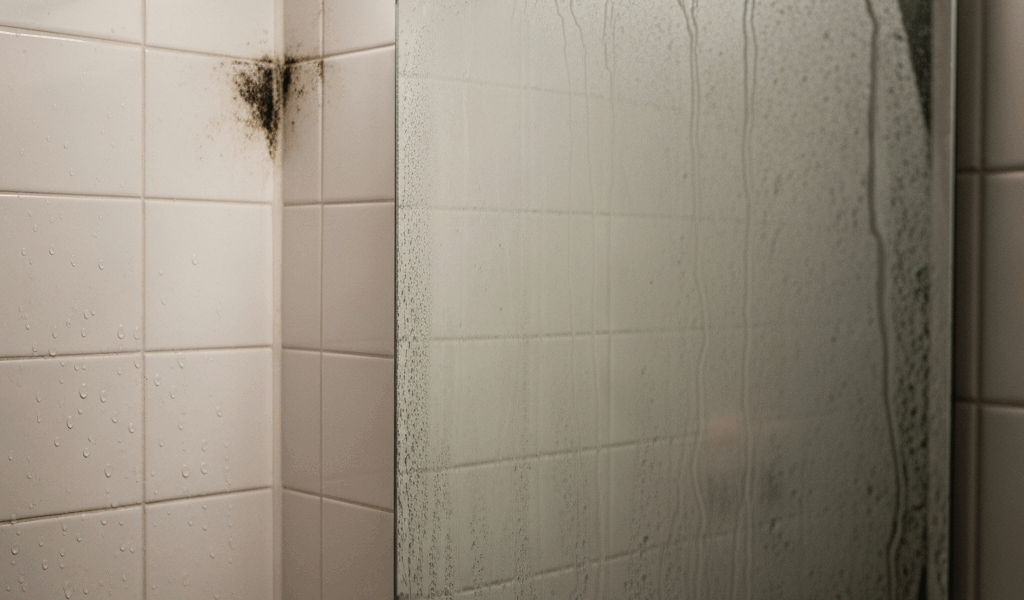
There are three real culprits. One: the duct is blocked, kinked, or sagging badly enough to choke off airflow entirely. Two: the fan’s CFM rating was never right for your bathroom size to begin with. Three: the backdraft damper is jammed open or missing, which matters enormously in cold weather or when coastal winds are pushing hard against your exterior wall. In wet climates, this isn’t a comfort issue. A fan that runs without exhausting traps moisture in your attic framing — and that’s how a $30 duct fix becomes a $4,000 mold remediation job.
How to Tell Where the Problem Actually Is
Start with the tissue test. Turn the fan on. Hold a single-ply tissue flat against the exhaust grille. If it barely flutters, you have no real airflow. If it slaps hard against the grille and stays there, your fan is actually working. Most people who call me convinced their motor is dead — it isn’t. The duct is the problem.
Probably should have opened with this section, honestly. Most homeowners troubleshoot the fan housing for an hour before anyone thinks to look at the duct run itself.
Assuming the tissue test failed, go into the attic with a decent flashlight — I use a Streamlight 66118, around $28 at Home Depot — and locate where the duct leaves the fan housing. You’re looking for three specific failures. First, sagging flex duct that’s drooped down and folded back on itself like a collapsed straw. Second, a tight kink at a 90-degree turn where an installer yanked the duct around a corner and crushed it flat. Third, the duct has simply pulled free from the fan outlet and is blowing conditioned air directly into your attic insulation.
Follow the full duct run to the exterior cap. Check whether it’s been painted over — I’ve seen damper louvers completely sealed shut with three coats of exterior latex. Check for insulation packed around and over the cap. These are five-minute fixes if you catch them.
Fixing a Blocked or Kinked Flex Duct
Two repair paths exist here. Simple straightening and re-securing of the existing duct, or a full replacement with rigid metal. The first is cheap and fast. The second is permanent.
For straightening: Kill the fan at the breaker first. Go into the attic and pull the sagging section upward, routing it directly toward the exterior cap without loops or tight bends. Secure it with galvanized metal duct straps — under $3 each at any home center — every 3 to 4 feet, fastened to ceiling joists. The duct should slope slightly downward toward the exterior cap, roughly 1/8 inch per foot of run. That slope keeps condensation from pooling inside the duct and eventually rotting your ceiling.
For kinked sections, work the flex duct open carefully by hand. If the inner walls are creased and won’t spring back, that section needs to go. Cut it out with a utility knife, slide in new flex duct — a 25-foot run typically runs $15–$30 at Lowe’s or Home Depot — and clamp each joint with two duct clamps, tightened down with a flathead screwdriver. Twenty minutes, maybe less.
But what about run length? In essence, it’s a CFM math problem. But it’s much more than that. If your duct run exceeds 25 feet, or bends through more than four 90-degree turns, flex duct will cost you meaningful airflow regardless of how cleanly it’s installed. Rigid 4-inch galvanized metal duct — around $1.50 per linear foot — moves air more efficiently and is worth the upgrade in those situations. That’s what makes rigid duct endearing to us Pacific Northwest homeowners dealing with long attic runs.
Replacing a Stuck or Missing Backdraft Damper
The backdraft damper lives inside your exterior duct cap. When the fan runs, the flapper swings open. When the fan stops, it closes — keeping outside air, insects, and the occasional confused starling out of your ductwork. In cold or windy conditions, a stuck-open damper lets outside pressure push air backward through the duct and straight into your bathroom. That’s not ventilation. That’s the opposite of ventilation.
Test it manually. Go outside, find the cap, and push the damper flapper with one finger. It should swing freely and close completely on its own. Stiff, rusted, or absent entirely? That’s your problem.
Replacing it is a 15-minute job. Loosen whatever’s holding the old cap to the duct — usually two or three sheet metal screws. Slide it off. If the damper just has years of grime and surface rust, soak it with WD-40 for five minutes and work it back and forth until it swings freely again. If it’s broken, a replacement duct cap with an integrated damper runs $25–$50 at most home centers. Bolt it on and seal the perimeter with high-temperature silicone caulk — Loctite makes a good one, about $8 a tube — to close off any air gaps around the cap edge.
When the Fan Itself Needs to Be Replaced
You’ve checked the duct. Clear and straight. The damper swings freely. The tissue test still fails. Now you’re looking at either a motor gone soft or a CFM rating that was never adequate for your bathroom.
So, without further ado, let’s dive into the math. Bathroom fans are rated in CFM — cubic feet per minute. The standard rule is one CFM per square foot of floor space, with 50 CFM as the absolute floor even for tiny bathrooms. A 50-square-foot half bath needs 50 CFM. A 100-square-foot primary bath needs at least 100 CFM. I’m apparently a 110-CFM person — a Panasonic FV-11VQ5 works for me while a 70-CFM Delta never quite cleared the mirror fog. In high-humidity climates, I’d lean toward the upper end of whatever range your bathroom qualifies for.
Older fans often top out at 50–70 CFM. Many current bathrooms run 80 square feet or larger. An undersized fan might run continuously and still leave visible moisture hanging in the air. That’s a mold risk, not a minor inconvenience.
Worn motor bearings are the other failure mode. After 10–15 years — sometimes less in humid climates — the ball bearings inside the motor degrade. The fan spins, makes its normal noise, draws its normal wattage, but delivers almost nothing in terms of actual airflow. The tissue test shows barely a flutter. There’s no repair for worn bearings. Replacement is the only answer.
A new bathroom exhaust fan with a correct CFM rating, sealed duct connections, and a functional backdraft damper will solve what no amount of motor troubleshooting ever could. Start in the attic first, though. Seriously. Start in the attic.




Stay in the loop
Get the latest northwest renovate updates delivered to your inbox.