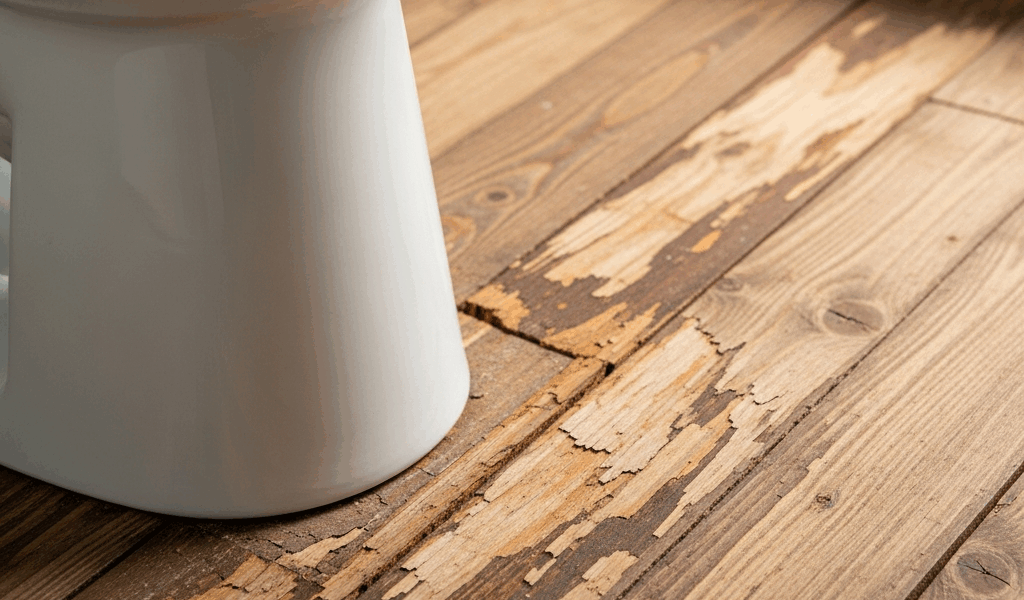
Why the Floor Feels Soft and What It Usually Means
Soft bathroom floors have gotten complicated with all the conflicting advice flying around. But here’s the thing — that spongy feeling under your feet near the toilet isn’t something you shrug off. A soft bathroom subfloor around a toilet usually comes down to three culprits, and figuring out which one you’re dealing with changes everything about how you handle it.
The most common offender is a failed wax ring. It sits between the toilet base and the flange, doing the quiet, unglamorous job of keeping water where it belongs. When it fails — and it always fails quietly — water seeps down slowly around the bolts or under the base itself. No dramatic gush. Just months of moisture sneaking into the subfloor below, unnoticed until your foot finds that soft spot.
Then there’s rotted subfloor. In the Pacific Northwest, where humidity never really takes a day off, old OSB and plywood absorb water like a sponge left in a sink. Crawl spaces with poor ventilation make everything worse. The wood loses structural integrity from the inside out. By the time you feel the softness underfoot, the damage is usually deeper than it looks — sometimes by a few inches.
Third is a cracked or sunken flange. The flange is the ring that bolts your toilet to the subfloor. Cracks it, or let it sink below the finished floor level, and the wax ring can’t seal properly anymore. Sewer gases find a way out. Water pools somewhere it absolutely shouldn’t.
Each problem has its own feel. A failed wax ring creates a soft spot directly beneath the toilet — maybe 4 to 6 inches in radius — and the floor bounces back when you press it. Rotted subfloor softness spreads wider and stays compressed. It doesn’t bounce. A flange issue usually announces itself through a rocking motion when you sit down or push on the tank. That’s what makes each problem distinct, which is genuinely useful once you know what you’re pressing for.
Older homes in Portland, Seattle, and Eugene with crawl spaces are especially good at stacking all three problems on top of each other. One failed wax ring creates moisture. That moisture hits joists already damp from poor drainage. The subfloor weakens. The flange sinks. Now you’ve got all three at once, and your Saturday just got a lot more complicated.
How to Tell If It Is the Wax Ring or the Subfloor
Probably should have opened with this section, honestly. Before you do anything else, spend ten minutes diagnosing the problem yourself. It saves money and prevents that sinking feeling of ripping up a floor you didn’t need to touch.
Check for discoloration. Look at the floor around the toilet base. Dark staining on tile, linoleum, or wood? Yellowish or brownish marks that weren’t there six months ago? That’s migrating water — weeks or months of it. Discoloration right under the bolts usually points to the wax ring. Staining that spreads toward the wall suggests a wider subfloor situation.
Rock the toilet. Sit on it normally and shift your weight side to side. A tiny amount of movement is fine — expected, even. But if the toilet shifts more than a quarter-inch either way, the flange is probably compromised or the subfloor beneath it has softened enough to matter.
Press the floor in a 12-inch radius around the base. Use your full body weight. Try the front, the sides, the back. Note where it feels softest. If only the 3 to 4 inches directly under the toilet base compress, the wax ring is likely your problem and the rest of the subfloor is probably fine. Soft area extending 6 inches or more in any direction? The subfloor itself is rotting or water-damaged. Different repair entirely.
Do the sniff test. Get close to where the toilet meets the floor. Sewer gas or rotten-egg odor — that’s hydrogen sulfide — means the flange is cracked or the seal is broken somewhere. A fresh urine smell usually just means the toilet has leaked for a while in the normal, unfortunate way. But a musty, damp, decaying smell? Mold is growing in the subfloor. That one’s a pro job. Don’t make my mistake of assuming a little mustiness was just “old bathroom smell.”
Most homeowners jump straight to “I need to replace the whole floor” when five minutes of diagnostics would have shown them it’s just the wax ring. So. Start here.
How to Check Under the Floor Without Demo
You do not need to rip anything up to know what’s happening below. So, without further ado, let’s dive in.
Crawl space inspection. If your home has a crawl space — common in PNW homes built before 1980 — get down there with a flashlight and look directly under the soft spot. You’re looking for dark staining on the rim joist or subfloor, joists that yield to thumb pressure, or panels that visibly sag. Beam looks dry and the plywood is hard? Damage is probably isolated to the surface. Black mold on the joists? Don’t poke at it. Call someone.
Borescope camera. A USB borescope runs $25 to $40 on Amazon — I use a Teslong model I bought for about $34. Drill a small hole, roughly 1/8 inch, in a hidden patch of tile grout or under a toilet bolt cap. Snake the camera in. You’ll see the subfloor material, its color, whether it’s wet or spongy. Five minutes, and you know almost everything. I once borrowed one from a neighbor — before I bought my own — and found three inches of dark, soft subfloor I never would have spotted otherwise. Saved me from demolishing the whole bathroom before I knew what I was actually fixing.
Screwdriver probe. Find the edge of the toilet base where caulk is already cracked or missing. Take a flathead screwdriver and gently probe the subfloor at the edge. Tip sinks in an inch without pressure? The subfloor is compromised. Stops after a quarter-inch with solid resistance? You’ve probably got a stable substrate with surface-level damage only. That distinction matters a lot for what comes next.
What You Can Fix Yourself vs What Needs a Pro
You can handle the fix if:
- The soft spot is only under the toilet base, under 12 inches in diameter, and bounces back when you press it
- The toilet is stable and doesn’t rock noticeably
- You have a crawl space and can access the joists from below
- The subfloor is wet but not rotted — you can probe it without the screwdriver sinking
- There’s no smell of sewer gas or mold anywhere in the room
In that case, replace the wax ring. Remove the toilet, scrape the old ring and putty away, install a new one. A quality Fluidmaster or Kohler ring runs $15 to $30 at any hardware store. Dry out the subfloor with a shop fan for three full days before reinstalling. I’m apparently sensitive to lingering moisture and a Ryobi shop fan works for me while a box fan never quite does the job. If the subfloor is soft but only at the surface, you can sister small joists alongside the existing ones from the crawl space — stabilizes the floor without a full demo.
Call a contractor if:
- The flange is cracked or sits below the finished floor level
- The soft area spreads beyond 6 inches from the toilet base
- The soft spot stays compressed — it doesn’t bounce back at all
- You smell sewer gas or mold
- The toilet rocks more than a quarter-inch
- You see black mold growth on any surface
- The subfloor softness extends toward the vanity or a wall
- Your home has a concrete slab foundation and water is pooling underneath it
These situations require subfloor replacement, flange repositioning, or mold remediation — sometimes all three. A general contractor or experienced handyperson with bathroom work on their resume will charge $800 to $2,500 depending on scope. That was just for a straightforward subfloor replacement in a 2004 bungalow I helped a friend navigate last spring. Mold present? Budget for a specialist — $1,500 to $5,000 is the realistic range.
Temporary Steps to Avoid Making It Worse
If you can’t get a contractor out immediately, do these things now. Not tomorrow.
- Stop using that toilet if the flange is unstable. Use another bathroom. Every time the toilet rocks, it widens the cracks and pushes more water into places it shouldn’t reach.
- Place a sheet of 3/4-inch plywood over the soft spot. Distributes your weight, prevents further compression, buys you time without making anything worse.
- Run the bathroom exhaust fan continuously. Keep the door open when the room isn’t in use. Humidity accelerates decay faster than most people expect. A 50-pint dehumidifier — around $100 to $200 at Home Depot — slows the rot cycle significantly in a small bathroom.
- Do not caulk around the toilet base yet. The subfloor needs to dry out. Sealing the perimeter traps moisture underneath and makes everything worse. Counterintuitive, but true.
The goal here is slowing the damage until a professional arrives — not patching it permanently on your own. There’s a real difference between those two things, and knowing which one you’re doing matters.


Stay in the loop
Get the latest northwest renovate updates delivered to your inbox.