Why Latex Paint Strippers Are Different
Paint stripping has gotten complicated with all the conflicting advice flying around. And honestly, most of it is wrong—not because the information is made up, but because it treats every paint type like it’s the same beast.
As someone who spent an entire Saturday last spring wrestling with a Victorian bookcase, I learned everything there is to know about choosing the wrong stripper at the wrong time. Methylene chloride, respirator on, windows wide open, a box fan wedged into the frame. Still got lightheaded around hour three. The paint came off, sure—but I was halfway through before it hit me. This was latex paint. Water-based. Responding to a chemical sledgehammer when all it needed was a flathead screwdriver.
But what is latex paint, exactly? In essence, it’s a water-based finish that forms a film when acrylic polymers are left behind after the water evaporates. But it’s much more than that—it’s a fundamentally different chemistry problem than oil-based paint, and that single distinction changes every decision you make about removal.
Methylene chloride and NMP—N-methyl-2-pyrrolidone, if you want the full name—were engineered for tougher, oil-based finishes. Using them on latex is like running a jackhammer to hang a picture frame. The tool works. It’s just absurd overkill, and the risks don’t scale down with it.
Probably should have opened with this section, honestly. Most homeowners stripping a latex-painted dresser or bedroom trim have no idea they can skip the toxic fumes entirely.
Citrus-based and soy-based strippers exist for exactly this reason. They use d-limonene and plant-derived solvents that dissolve acrylic binders without the vapor situation. Slower? Yes—you’re waiting 30 minutes to two hours instead of 15. But for latex specifically, the results hold up once you apply them correctly, and you’re not airing out the garage for three days afterward.
That’s what makes non-toxic strippers endearing to us weekend DIYers. I can crack the garage door, put on a single pair of nitrile gloves, and work without checking over my shoulder. With methylene chloride, the PPE list alone takes ten minutes to assemble.
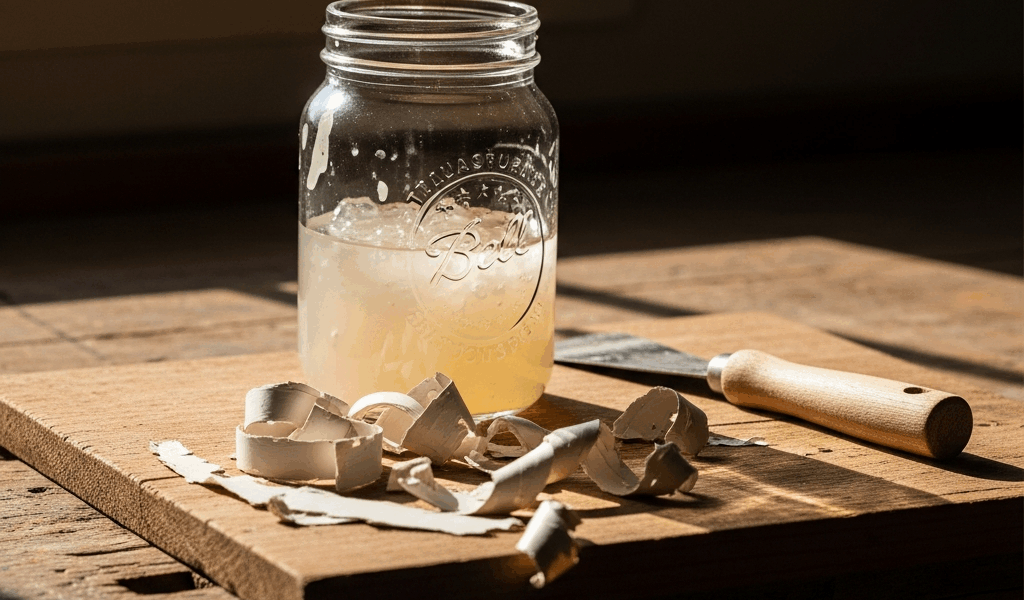
There’s also the residue factor—something nobody talks about enough. Latex strippers leave a water-soluble sludge behind. Scrape it, wipe with a damp cloth, move on. Oil paint strippers often leave waxy buildup that needs aggressive scrubbing or a secondary solvent. For latex jobs, you skip that entire step.
Top 3 Non-Toxic Latex Paint Strippers Tested
Citristrip Original Formula
Citristrip uses d-limonene—a natural solvent pulled from citrus peels—as its active ingredient. The smell hits you immediately. Unmistakably orange, somewhere between a cleaning product and a bag of clementines. Not unpleasant, just present.
I ran two tests: latex paint over a wood bedroom dresser, and latex flat finish on drywall in my basement.
On the dresser, I applied it a quarter-inch thick. Waited 30 minutes. The paint was already lifting at the edges. By 45 minutes, I could take off large sections with a plastic putty knife without forcing it. Some scrubbing was required—it didn’t peel back like wallpaper—but the effort was manageable. Total time including cleanup came out around 90 minutes.
On drywall, things got humbling fast. The flat latex finish didn’t lift decisively. I hit maybe 60% removal before the scrubbing started damaging the drywall paper underneath. Don’t make my mistake—that’s not a stripper failure, that’s a substrate problem. Flat latex on drywall embeds into the surface. For that situation, a heat gun or simple skim-coat-and-repaint is genuinely the smarter call.
Price runs $12–$16 per quart depending on the retailer. A quart covers roughly 150 square feet in a single application—competitive across the board.
One genuine caution: d-limonene irritates skin with prolonged contact, and it’s still flammable despite the non-toxic profile. Gloves aren’t optional. Keep open flames and heat sources out of the workspace.
Dumond Smart Strip
Dumond’s formula is noticeably thicker—almost a proper gel—which immediately solves the vertical-surface dripping problem that frustrates people with Citristrip. Applied to a wall or door casing, it stays where you put it.
Back on the same dresser: 60-minute dwell. The paint wrinkled and bulged rather than softening uniformly—a different visual from Citristrip. When I scraped, it came off in larger, more intact sheets. Less scrubbing overall. On wood, this was the cleaner result of the two.
On latex-painted MDF kitchen trim, the performance held up well. No over-softening of the substrate, no damage to the edge banding—something overly aggressive chemical strippers have wrecked for me before.
Price sits at $15–$18 per quart. Slightly higher, but the thicker formula stretches further per application, so the math evens out.
The honest gap: Dumond’s exact chemical composition isn’t fully disclosed. They market it as non-caustic and non-flammable—true, apparently—but that doesn’t cover volatility or long-term exposure effects completely. For someone who wants to know precisely what they’re breathing in an enclosed space, that ambiguity matters.
Soy Gel
This is the wild card of the three. Soy-based strippers use soybean oil derivatives as the primary solvent—gentler than citrus options, significantly less volatile, and with a health profile that makes indoor use feel genuinely low-risk.
I used Soy Gel on latex-painted hardwood flooring in a guest bedroom. Quarter-inch application, 90-minute dwell. The paint softened uniformly across the surface. Scraping required moderate pressure with a plastic scraper—no gouging of the floor underneath. The odor was earthy, almost neutral. Nothing that would run you out of the room.
Cleanup was where this product actually surprised me. Water and a cloth took everything off. No secondary solvent, no mineral spirits, no residue chasing. If you’re working near living spaces—a bedroom, an interior hallway—that matters considerably.
Price runs $18–$22 per quart, making it the most expensive of the three. Coverage is comparable to the others.
The real limitation: thick, multi-coat latex buildup defeats Soy Gel. Three stacked paint layers from different decades—1980, 1995, 2005—will get the top coat lifted cleanly while the rest sits there unbothered. Citristrip or Dumond handles that scenario better. Soy Gel might be the best option for single-coat or light applications, as the softer chemistry requires a thinner film to penetrate fully. That is because soy-derived solvents work through gradual absorption rather than aggressive chemical disruption.
Application Method Matters More Than You’d Think
Coat thickness is everything. Thin coats dry out before the solvent gets to work—don’t let anyone tell you otherwise. I learned this on a cabinet door: applied an eighth-inch layer, waited 45 minutes, got maybe 20% lift. Reapplied at a quarter-inch, same wait time, got 85% lift. Same product. Same surface. Same day.
Temperature and humidity quietly control your dwell time. Sixty-five degrees versus 75 degrees adds roughly 20 minutes to the wait. On humid days, water-based latex paints can resist stripping more stubbornly—apparently the moisture in the air slows how the solvent moves into the paint film, though the exact mechanism varies by product.
Scraping direction on wood isn’t optional advice. Work with the grain. Scraping against it tears wood fibers—especially in pine, spruce, or any softwood. I’ve watched people blame the stripper when the real problem was fighting physics.
Heat Gun vs Chemical Stripper for Latex
Stripped by impatience, most homeowners reach for a heat gun before anything else. I get it—watching paint bubble up and peel away is deeply satisfying. But for latex specifically, chemical strippers win on speed, safety, and what the final surface actually looks like afterward.
Heat guns need to hit 600–800°F at the paint surface to soften latex effectively. At those temperatures, you’re also drying out wood fibers, stressing drywall, and introducing scorch risk on anything you want to keep looking good. Wood scorches permanently—you can’t sand it back to clean.
The safety math: heat guns keep you away from vapor exposure. That’s a real advantage. But they introduce burn risk—I’ve singed forearm hair twice, unfortunately—and they don’t actually outpace a non-toxic chemical stripper on latex. You’re swapping one risk for another, not eliminating risk entirely.
Lead paint changes everything here. If your latex was applied over old lead-based primer—common in anything painted before 1978—a heat gun aerosolizes lead particles. Chemical strippers keep lead contained within the softened paint film; it doesn’t go airborne the same way. If there’s any uncertainty, test before you start. Home Depot carries lead test kits for around $15 a pack.
The hybrid approach is what I actually use now. Light heat gun pass to soften and blister the surface, then chemical stripper to handle the rest. On a dresser with 30-year-old latex paint, this combination runs about two hours instead of three—and without pushing the heat long enough to risk scorch marks.
For drywall, heat guns are nearly useless. The paper backing burns before the paint yields. Latex removal on drywall is honestly one of the few scenarios where I’d recommend accepting that you can’t win cleanly—sand smooth, prime, repaint. It’s faster and the result looks better than a drywall surface you’ve damaged trying to strip it.
Surface-Specific Tips
Wood — Soy-Based Strippers Shine Here
Solid hardwood responds best to soy-based strippers. The gentle, low-volatility action preserves grain detail without the scorch risk a heat gun introduces. Dwell time is longer, but the surface you’re left with needs minimal sanding before stain or finish goes on.
Application: brush on thick, wait at least 90 minutes, scrape at a 30-degree angle with a plastic putty knife. Wipe residue with a damp cloth. A light pass with 120-grit sandpaper handles any leftover roughness, but usually a wipe is sufficient.
MDF and plywood are different. Citristrip performs better on both. MDF swells when over-saturated with moisture—soy-based strippers leave more water residue than citrus-based ones, and that extra moisture adds swelling risk on composite materials.
Metal — Chemical Stripper Plus Aggressive Scraping
Wrought iron railings, steel fire escapes, aluminum trim—metal surfaces respond fastest to chemical strippers. Dwell time is shorter, around 30 to 45 minutes with Citristrip, and the paint release is decisive rather than gradual.
Metal is forgiving on the substrate damage front, so wire brushes and metal scrapers are fair game. After scraping, a wire wheel on a drill cleans up stubborn residue quickly. Finish with a cloth dampened in mineral spirits to pull any remaining stripper off the surface before priming.
One thing strippers won’t solve: rust underneath. If the metal has corroded, you’ll need a rust converter or need to grind back to clean metal separately. The stripper handles the paint. The rust is its own project.
Brick and Masonry — Pressure Washing May Be Faster
Latex paint on brick is a commitment. Chemical strippers work, but covering large masonry surfaces—a full exterior wall, for example—turns dwell time management into a part-time job.
High-pressure washing at 3,000 PSI and above can remove latex paint from brick faster than chemical methods on large areas. The paint chips away under sustained water pressure. This only holds if the brick itself is in solid condition—soft or deteriorating brick won’t survive that pressure intact.
If chemical strippers are the right call for your masonry: Citristrip or Dumond both work. Apply generously. Let it sit the full recommended dwell time without rushing. The paint releases in sections rather than all at once. Scrape, follow up with a stiff brush, rinse thoroughly with water.
One real downside to chemical strippers on exterior brick—efflorescence. The white mineral deposits that sometimes appear on brick after water exposure can be triggered or worsened by stripper residue left in the pores. Rinse thoroughly and give the surface time to dry completely before deciding whether the job is done.



Stay in the loop
Get the latest northwest renovate updates delivered to your inbox.