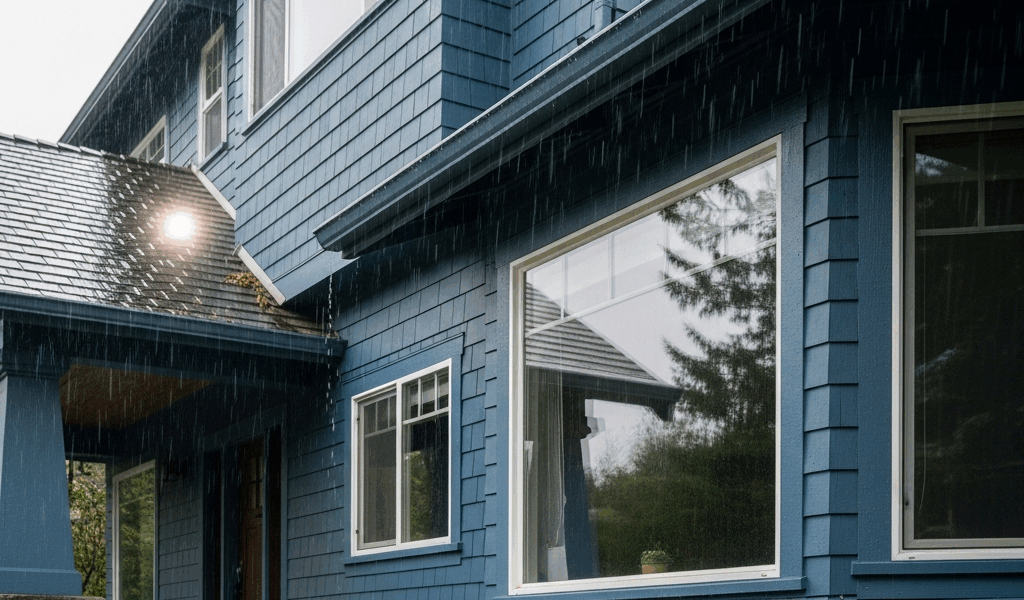
Best Exterior Paint for Rainy Climates — What Holds Up in the Pacific Northwest
Exterior paint for rainy climates has grown more complex with the “universal” buying guides flying around — most of them written by people who’ve never watched a paint job fail in a Portland November. I learned this the hard way after repainting my 1967 cedar-sided house in Beaverton, Oregon with a product my contractor swore by. Glowing reviews everywhere. Gone within 18 months — blistering right along the window trim, peeling in sheets by spring. Fifty-two inches of rain that year. The paint was probably fine in Arizona. Up here, it was garbage.
What follows is what I actually know about painting homes in the Pacific Northwest — after that expensive lesson, two subsequent repaints, and a lot of conversations with painters who’ve been working the Portland-to-Seattle corridor for decades.
Why Generic Exterior Paint Recommendations Fail in the Pacific Northwest
The Pacific Northwest is genuinely its own thing. Portland averages around 37 inches of annual precipitation. Seattle sits closer to 38. Head toward Olympia or into the Coast Range foothills and that number climbs past 55. Atlanta gets about 50 inches a year — often cited as a humid, rainy city — but Atlanta also gets hot, dry summers where surfaces actually bake out between storms. The PNW gets wet in October and stays wet, overcast and persistently damp, straight through May.
That seasonal pattern does specific things to paint. Extended wet periods — sometimes weeks without a real drying window — mean moisture wicks into wood siding and just sits there. Paint films that can’t flex when the wood swells end up trapping that moisture underneath. Then you get blistering. Then peeling. Then bare wood exposed to even more moisture. Cedar and Douglas fir siding — standard on PNW homes built between the 1940s and 1980s — moves significantly with seasonal changes. That’s what makes this region so brutal on coatings.
Generic paint reviews don’t test for any of this. They test coverage, color retention, scrubability. Nobody in a paint lab in New Jersey is running a 90-day extended moisture exposure test on vertical cedar siding. Mildew resistance — honestly the single most important exterior paint property in western Oregon and Washington — gets treated as a marketing checkbox rather than anything tested with real rigor.
What to Look for in High-Rainfall Exterior Paint
This is the piece to know up front. Before you look at any specific product, here’s the short list of what actually matters in a wet climate.
100% Acrylic Latex — Not Oil, Not Alkyd
Non-negotiable. 100% acrylic latex stays flexible as wood expands and contracts through wet seasons — it breathes. Oil-based and alkyd paints harden over time, and hardened paint on wood that moves will crack. Once it cracks, water gets in. In a climate pulling 40-plus inches of rain annually, that crack becomes a serious problem by year three.
There’s another issue with oil-based paint on PNW wood siding — it traps moisture under the film rather than letting it pass through. You’ll see it as bubbling along the bottom edges of siding boards, where water sits longest after a storm.
Mildewcide Content — Ask for the Product Data Sheet
Every premium exterior paint brand claims mildew resistance. Not all of them actually disclose their mildewcide concentration in consumer-facing materials — and there’s a real difference between brands on this. Ask for the product data sheet, the PDS, not the marketing spec sheet. The PDS lists actual chemical composition and mildewcide percentage. Sherwin-Williams will hand you one at the store counter if you ask. Benjamin Moore reps can pull them up. If a paint company won’t give you the PDS, move on.
Film Thickness — Minimum 4 Mils Dry
A dry film thickness of 4 mils or higher gives you real protection in a high-rainfall environment. Thinner films wear faster — especially on south and west faces that cycle between soaking wet and UV exposure. Coverage rates printed on the can assume standard spread rates. In practice, two coats over a good primer is where you need to land.
What to Avoid
- Oil-based topcoats on any wood siding
- Paints marketed for “all climates” without specific mildewcide disclosure
- Single-coat application claims on bare or weathered wood
- Budget exterior paints below about $50 per gallon — the mildewcide and resin quality simply aren’t there
Top Exterior Paint Picks for Wet Climates
Humbled by that first Beaverton repaint, I’ve personally used three of these products and talked at length with painters who’ve used all of them on homes across western Oregon.
Sherwin-Williams Emerald Exterior
This is my current pick for most PNW homes. The mildewcide content is the highest in the Sherwin-Williams exterior lineup — the store reps will confirm it if you ask directly. It’s 100% acrylic, self-priming over previously painted surfaces in decent condition, and it lays down a substantial film. Price runs $90 to $100 per gallon as of this writing. Expensive — no way around it. A full exterior on a 1,500 square foot home will need 10 to 15 gallons depending on siding type. Budget accordingly, or sticker shock will hit you mid-project.
Benjamin Moore Aura Exterior
Exceptional adhesion in wet conditions. Painters I know in the Portland metro specifically mention Aura holding better on north-facing walls — the ones that stay damp longest — compared to other premium acrylics. Strong mildew resistance, though the mildewcide formulation differs from Emerald’s. Price is comparable, around $85 to $95 per gallon. Benjamin Moore dealers aren’t as ubiquitous as Sherwin-Williams stores, but there are solid dealers throughout Portland and Seattle if you look.
Behr Marquee Exterior
The value option — available at Home Depot, usually $55 to $65 per gallon. Mildew resistance is genuinely good, better than lower-tier Behr products, and the 100% acrylic formula holds up reasonably well in moderate conditions. I wouldn’t use it on a house with active moisture problems or badly weathered siding. But for a well-prepped home in moderate PNW conditions, it performs at a significantly lower cost than the premium options. Don’t dismiss it just because it’s cheaper.
Sherwin-Williams Duration — For Problem Siding
Duration has elastomeric properties that make it worth a serious conversation for siding with significant movement history. It bridges minor cracks. On homes where previous paint jobs have a documented history of cracking along siding joints, Duration is worth discussing with your painter before you commit to anything.
Elastomeric Paint — When to Use It on NW Homes
Elastomeric coatings are a different category than standard acrylic paint entirely — and the Pacific Northwest is exactly where they earn their cost premium.
Here’s the specific situation they solve: older cedar or Douglas fir siding — especially on homes from the 1950s through 1970s — has been expanding and contracting through wet seasons for half a century. The wood moves. Standard paint, even premium acrylic, develops hairline cracks along board edges and siding joints after five to seven years. Those cracks let water in. In a climate with 50 inches of annual rain, that’s a moisture infiltration problem that compounds fast.
Elastomeric coatings stretch — literally. They carry elongation ratings of 100% to 300%, meaning they flex with wood movement rather than cracking against it. Applied at the right film thickness — typically 10 to 20 mils wet, compared to 4 mils for standard paint — they bridge existing hairline cracks and prevent new ones from forming.
The cost premium is real. Expect elastomeric coatings to run 30% to 50% more than premium acrylic per gallon, and they typically require professional application for best results. The value calculation depends on your repaint cycle. A standard premium acrylic on an older PNW home might need repainting every five to seven years. A properly applied elastomeric on the same home can realistically go 10 to 12 years. Do the math on your house size — it shifts the conversation.
Not every home needs elastomeric. Newer fiber cement siding doesn’t move the way old-growth cedar does. For those homes, Emerald or Aura is sufficient and probably the smarter spend.
Prep Is More Important Than Product in Wet Climates
Side-step the error I made. It took two failed paint jobs for me to fully accept this — the prep work matters more than which premium paint you choose. More than brand loyalty, more than price per gallon.
In a climate pulling 50 inches of rain, every shortcut in surface preparation becomes a failure point. Here’s what proper prep actually looks like on a PNW home.
Power Wash First — And Mean It
Mildew is present on virtually every exterior surface in western Oregon and Washington — even surfaces that look clean. Power washing removes the bulk of it. Use a 1,500 to 2,000 PSI setting on wood siding — enough to clean aggressively, not enough to raise the grain or drive water deeper into the wood.
Treat Remaining Mildew Before Priming
Power washing doesn’t kill mildew. It moves it around. Any remaining mildew staining needs a bleach solution treatment — typically 1 part bleach to 3 parts water — before you prime anything. Let it dwell, scrub it, rinse it off. Then let the surface dry completely. In PNW weather, “completely dry” can mean waiting for a genuine dry spell, which realistically points toward scheduling your repaint in August or early September.
Prime Bare Wood With Oil-Based Primer
But what about everything I said about avoiding oil-based products? In essence, that applies to topcoats — not primer. Oil-based primer on bare wood, even under an acrylic topcoat, provides superior adhesion and moisture blocking right at the wood interface. It’s much more than a counterintuitive workaround — it’s what actually works. Sherwin-Williams Exterior Oil-Based Wood Primer is the one painters have recommended to me repeatedly. It penetrates weathered wood in a way water-based primers just don’t match.
Caulk Every Gap Before Painting
Every butt joint. Every gap around window and door trim. Every penetration through the siding. Paintable polyurethane caulk — not silicone. In a climate that drives rain horizontally during a November storm, any unsealed gap is a water entry point that will eventually fail your paint job from behind, and you won’t see it happening until the damage is already done.
Skip any one of these prep steps on a home in the Willamette Valley or the Puget Sound lowlands and it doesn’t matter whether you used Emerald or Marquee. You’ll be repainting in three years instead of ten.
The Pacific Northwest demands more from exterior paint than most of the country does — that’s just the reality of living here. The products exist to meet that demand. The prep process exists to let those products actually do their job. Get both right, and a proper repaint should carry your home through a solid decade of rain without drama.

Stay in the loop
Get the latest northwest renovate updates delivered to your inbox.