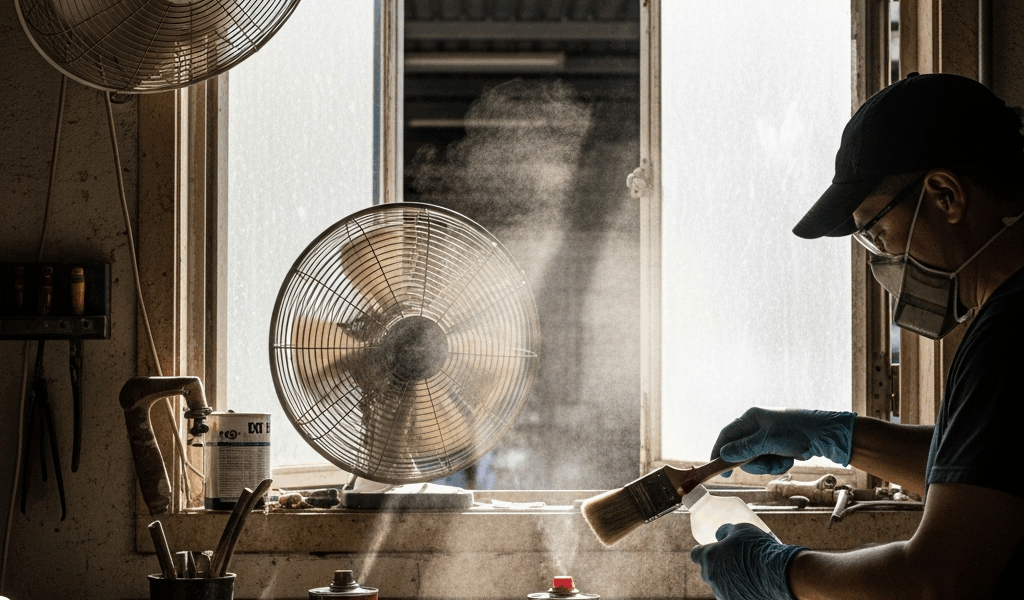
How Long Do Mineral Spirits Fumes Take to Clear? Ventilation Guide
How long mineral spirits fumes take to clear depends almost entirely on your specific situation — and I say that as someone who spent years doing finish carpentry and cabinet refinishing before I learned to stop guessing and start paying attention. The short version: a thin application in a ventilated room? Fumes drop to safe levels in 15 to 20 minutes. A heavy soak into concrete or bare wood? You could be dealing with residual odor for a week. I’ve walked back into a shop the morning after a big refinishing job and still gotten a headache before I hit the light switch. That experience taught me more about ventilation than any safety sheet ever did.
The Short Answer — 15 to 20 Minutes to Hours
Here’s what I tell anyone who asks me on a job site. Thin application, hard non-porous surface like glass or sealed metal, two windows open and a fan running — 15 to 20 minutes and the active fume concentration is low enough that most people won’t notice it. That’s not “completely gone.” That’s “won’t knock you sideways.” The odor itself, the faint petroleum smell, can linger for 24 to 72 hours in a typical room even after the concentration is below concern thresholds.
Heavy applications change everything. Wiping down a freshly stripped wood floor with Klean-Strip mineral spirits — the kind in the green quart can — lets those fumes absorb into the grain and release slowly over hours. I’ve seen situations where a bathroom floor refinish had detectable odor three days later because the grout absorbed the solvent. Porous concrete in a garage can hold mineral spirits fumes for five to seven days if the slab is cold and airflow is minimal.
Rough timeframe breakdown by scenario:
- Thin wipe on glass or metal, windows open: 15–20 minutes to safe working levels, 2–4 hours for odor to clear
- Brush cleaning in a ventilated room: 30–45 minutes for active fumes, 12–24 hours for full odor clearance
- Moderate application on sealed wood: 1–3 hours for active fumes, 24–48 hours for odor
- Heavy application on bare or porous wood: 3–6 hours for active fumes, 48–72 hours for odor
- Spill or heavy use on concrete: 6–12 hours for active fumes with ventilation, up to 7 days for full odor dissipation
Probably should have opened with this section, honestly. Most people searching this question need to know whether they can sleep in the house tonight, not a chemistry lecture.
Why Your Scenario Matters — Ventilation Factors
The same half-pint of mineral spirits will off-gas completely differently in a 400-square-foot bedroom versus a 12×12 bathroom versus an open garage bay. Room volume matters. So does surface type. So does temperature — cold air holds fumes lower and longer, which is why winter garage work is way more dangerous than summer work with the door cracked.
Surface Porosity
Glass releases mineral spirits almost immediately. It doesn’t absorb. Bare concrete is the opposite — it wicks solvent into its pores and then breathes it back out slowly as temperature and humidity fluctuate. Unsealed hardwood sits somewhere in the middle. I once did a walnut countertop prep job using about two cups of odorless mineral spirits (Sunnyside brand, the 1-gallon jug from my local Ace Hardware, ran about $14 at the time). Odorless doesn’t mean fume-free, by the way — that’s a myth I held onto too long. Odorless mineral spirits still off-gas hydrocarbons. You just can’t smell the early warning sign, which is arguably worse.
Room Size and Air Changes
A single open window in a small bathroom creates almost no air movement without a pressure differential. You need air coming in and air going out. Without cross-ventilation, fumes just pool near the floor — mineral spirits vapors are heavier than air — and the concentration stays elevated for hours longer than it should. A 10×10 room with one window open might take four times as long to clear as the same application in a room with two windows on opposite walls.
Scenario Comparison Table
| Scenario | Surface Type | Ventilation | Active Fumes Clear | Odor Gone |
|---|---|---|---|---|
| Brush cleaning, shop sink | Metal container | Open garage door | 20–30 min | 2–4 hours |
| Floor prep, sealed hardwood | Sealed wood | Two windows open | 1–2 hours | 24–36 hours |
| Floor prep, bare pine | Porous wood | One window open | 4–6 hours | 48–72 hours |
| Spill cleanup, concrete | Bare concrete | No ventilation | 12–24 hours | 5–7 days |
| Cabinet wipe-down, kitchen | Finished wood | Fan + open window | 30–45 min | 12–24 hours |
How to Speed Up Ventilation
Cross-ventilation is the single most effective thing you can do. Two openings on opposite sides of a space — one low where air enters, one higher where it exits — creates a natural draft that pulls fumes out far faster than any single fan can manage. Physics does the work. You’re just setting up the conditions.
Fan Placement
Burned by bad fan placement on a kitchen job years ago, I started being deliberate about this. A box fan sitting in a window blowing outward pulls fresh air in through any other opening in the room and exhausts fumes-laden air outside. That’s the setup. Do not point a fan inward and hope it mixes the air — all that does is keep you company while the fumes go nowhere useful.
I use a Lasko 3723 box fan, the 20-inch model. About $35 at most hardware stores. Set it in the window on the exhaust side, gap-filled around the edges with a piece of cardboard so the fan isn’t just recirculating room air around its own frame. Run it the entire time you’re working and for at least 30 minutes after you’re done. On larger jobs, I run two — one exhausting in the work area, one exhausting in an adjacent room to prevent fumes from migrating.
While You’re Still Working
Don’t wait until you’re done to think about ventilation. Set it up first. And wear a respirator rated for organic vapors — not a dust mask, not an N95, those do nothing for solvent fumes. A 3M 6502 half-face respirator with organic vapor cartridges (the OV/P100 combination cartridge, part number 60921, around $20–$25 for a pair) is what I reach for on any job using more than a few ounces of mineral spirits in an enclosed space. It feels like overkill until the one time it isn’t.
Temperature and Humidity
Warm air moves fumes faster. If it’s 45°F in your garage, open the door but accept that clearance will take longer. Humidity slows evaporation slightly. High humidity on a porous surface can trap solvent and extend off-gassing. Nothing dramatic — but worth knowing if you’re wondering why that bathroom still smells three days later during a rainy week.
When Mineral Spirits Fumes Are Dangerous
This is not a medical advice section. It’s practical awareness from years of working with solvents. The OSHA permissible exposure limit for mineral spirits is 100 ppm (parts per million) as an eight-hour time-weighted average. That number matters because it tells you the danger is cumulative — brief exposure in a well-ventilated room is very different from working in an enclosed space all day.
Symptoms to Know
Mild overexposure shows up as headache, dizziness, and eye irritation. Those are your warning signs. Leave the room immediately. Get fresh air. These symptoms usually resolve within 30 minutes once you’re away from the source. Nausea and disorientation signal heavier exposure. If someone is confused or difficult to rouse, that’s an emergency — not a “let’s open a window” situation.
When to Leave Without Finishing the Job
The moment you notice your eyes watering and your head going fuzzy — stop. It’s not dramatic, it’s just smart. No finish coat is worth a bad afternoon. I’ve walked off jobs mid-brush because the ventilation I thought was adequate clearly wasn’t. Came back the next morning with better setup and finished in an hour. The work doesn’t suffer. Your health might.
Small spaces with no ventilation options — a closet, a sealed basement room, an interior bathroom with no window — are situations where I either set up mechanical exhaust before I start or I don’t use mineral spirits at all. Waterborne alternatives have gotten genuinely good over the past ten years. Sometimes the right call is switching products, not grinding through a ventilation problem.
Residual Odor vs. Actual Fume Concentration
One last thing worth knowing. By the time you can barely detect the smell, the concentration is almost certainly well below any dangerous threshold. Humans can detect mineral spirits odor at concentrations far lower than what poses health risk. Lingering smell after 24 to 48 hours in a ventilated room is mostly a nuisance, not a hazard. That said, if the smell is still strong — not faint, strong — after several hours of active ventilation, something is still off-gassing at a significant rate and the space needs more air movement before you use it normally.
The goal is always to get ahead of the problem. Set up ventilation before you open the can, not after you’ve already noticed the smell building. That single habit change has made every solvent job I do safer and faster to clear.




Stay in the loop
Get the latest northwest renovate updates delivered to your inbox.