“`html
USA Insulation Foam vs Fiberglass — Which Wins
I’ve torn out insulation from three different homes in the past eighteen months, and I can tell you the foam board versus fiberglass question isn’t actually mysterious once you stop comparing list prices and start comparing what it costs to actually have R-38 in your attic. Most homeowners choose between USA Insulation foam board products and fiberglass batts without doing the math that matters — the installed cost per R-value in their specific climate. That’s the mistake I made on my first project, and it’s the reason I’m writing this for anyone else standing in a supply yard in Oregon or Washington trying to figure out which product makes financial sense.
The Pacific Northwest isn’t Kansas. Our insulation challenges are different — high humidity, rain-driven moisture, and that structural dampness that comes from living in a rainforest-adjacent region mean some insulation products perform differently here than they do in dry climates. I’m going to walk you through the actual costs, installation realities, and moisture performance data so you can make a decision instead of guessing.
Cost per R-Value — The Real Number That Matters
Here’s what I learned: quoting insulation by brand name is useless. You need to know what it costs to achieve R-38 in your 1,200-square-foot attic using each product, including materials and labor if you’re hiring out.
USA Insulation foam board — specifically their 2-inch rigid XPS products providing R-10 to R-12.6 depending on formulation — runs roughly $0.95 to $1.20 per square foot for material in the Pacific Northwest as of 2024. That 1,200-square-foot attic costs $1,140 to $1,440 in materials alone. Reaching R-38 requires multiple layers, typically three 2-inch boards stacked vertically, which pushes your material cost to $3,420 to $4,320 before labor. Professional installation runs $1.50 to $2.00 per square foot for foam board — another $1,800 to $2,400. Total project cost lands at $5,220 to $6,720.
Fiberglass batts, the standard R-38 type sold at Home Depot and specialty suppliers, cost $0.35 to $0.50 per square foot for material. Your 1,200-square-foot attic needs just one layer of R-38 batts, so materials total $420 to $600. Professional installation for fiberglass runs $0.75 to $1.25 per square foot — adding $900 to $1,500. Total project cost: $1,320 to $2,100.
The cost-per-R-value metric shows the real story. Foam board runs roughly $137 to $177 per R-value point achieved (total cost divided by R-value). Fiberglass R-38 batts? $35 to $55 per R-value point. That’s a difference of $3,900 to $4,600 for the same thermal performance in your attic. Probably should have opened with this section, honestly — the cost gap is why most homeowners aren’t choosing foam board for attic work.
The exception appears when you’re insulating concrete basements or crawl spaces where moisture dominates. But for attic insulation in a 1,200-square-foot space, fiberglass wins on dollars.
Installation Speed and DIY Feasibility
Gripped by misguided confidence, I attempted to install foam board in a rim joist cavity without proper measurement tools and learned a valuable lesson about precision very quickly.
Fiberglass batts are forgiving. You cut them roughly to size with a utility knife, stuff them into joist cavities, and if the fit isn’t perfect, the batt compresses and you move forward. A homeowner with basic tools can install R-38 batts in a 1,200-square-foot attic in eight to twelve hours. You need a utility knife, a straightedge, and protective gear — respirator, gloves, long sleeves. The batts unroll, you cut, you fit, you staple the tabs if they have them. The learning curve is shallow.
Foam board demands precision. You’re cutting rigid sheets to exact dimensions, fitting them into cavities with minimal gaps, and often creating a vapor barrier system that requires tape and caulk at every seam. Three layers mean accounting for stagger patterns and ensuring seams don’t align vertically. Tools get more specialized: circular saw, table saw (or rental access), straightedge, measuring tape. Installation time for the same 1,200-square-foot attic stretches to fifteen to twenty-five hours for someone doing it for the first time. The forgiveness factor is lower — a poorly fitted foam board creates thermal bridging at every gap.
For DIY attic insulation, fiberglass wins on difficulty. For basement rim joists or crawl space work where precision cavity-fitting is already required, the difficulty difference narrows and the moisture benefits of foam board become relevant enough to justify the extra time.
Moisture and Mold Risk in Pacific Northwest Climate
This is where the regional climate actually matters — and where most online comparisons fail to account for local weather patterns.
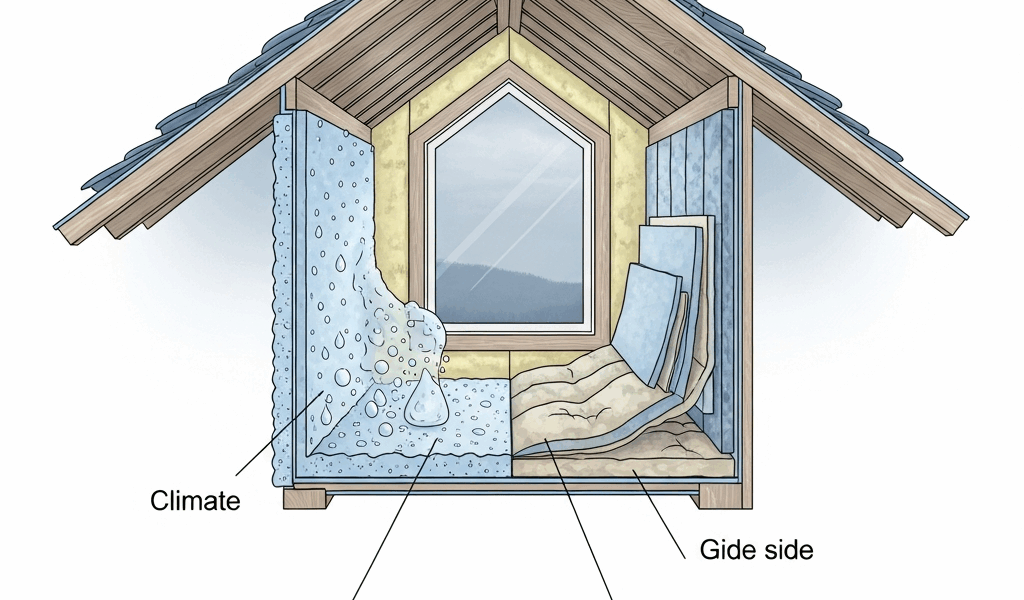
Fiberglass batts are hygroscopic. They absorb and release moisture based on ambient humidity. In the Pacific Northwest, where humidity sits at sixty to eighty percent year-round and rain drives moisture into building cavities, fiberglass batts retain liquid water. The specific failure pattern I’ve seen repeatedly: water enters an attic through a roof leak, fiberglass retains that moisture, and because the cavity traps humid air (especially in homes without proper attic ventilation), mold develops within the batt itself. The batt becomes a moisture vector. By the time you see the problem, it’s been growing for months. I pulled batts from a 1970s home in Portland that had visible mold colonies inside the fiberglass — the insulation itself had become a breeding ground.
Rigid foam board — XPS or polyiso — is vapor-impermeable. Water doesn’t migrate through it, and it doesn’t support mold growth because mold requires materials that can absorb moisture. The specific failure pattern with foam board in the PNW: improper air sealing. Install rigid foam without sealing every seam with foam-rated caulk or spray foam, and warm interior air leaks into the cavity, condenses on the foam surface or back of roof decking, creating mold on the wood framing rather than the insulation. The failure isn’t the product itself — it’s the installation methodology. Foam board in an attic requires perfect air sealing or it creates a condensation trap.
For a PNW attic with reliable roof integrity and proper ventilation, fiberglass batts perform fine if you’re willing to accept that moisture wicking is part of the system. For a basement or crawl space where liquid water exposure is real, foam board’s impermeability prevents saturation and mold risk from ground moisture.
When Foam Board Wins (Specific Use Cases)
Attics? Fiberglass. Basements are different.
Use foam board for basement insulation — concrete walls are in contact with surrounding soil moisture year-round, and that moisture will migrate into and through fiberglass batts. A fiberglass-insulated basement wall in a PNW home becomes a humidity reservoir. Two inches of rigid XPS foam board installed against the concrete, with all seams sealed, blocks that moisture migration. Your basement stays dry because the insulation prevents vapor transmission from the concrete to the interior air. A 1,200-square-foot basement (roughly 800 linear feet of perimeter wall at eight feet high) requires sixteen hundred square feet of foam board. At $0.95 per square foot, materials run $1,520. Sealed properly, that investment prevents mold and maintains building durability. Fiberglass in that same space costs $560 for materials but absorbs and desorbs moisture continuously, eventually degrading and supporting mold growth on the concrete or framing behind it.
Use foam board for rim joists and band board cavities for the same reason — these are boundaries between unconditioned and conditioned space where moisture infiltration is common. A typical home has 400 to 600 linear feet of rim joist. Foam board cut to fit and sealed with caulk costs roughly $400 to $600 in materials and prevents moisture-related rot in that critical transition zone.
Use fiberglass batts for attic insulation in the PNW unless your roof has chronic leak issues or you have no attic ventilation. The cost difference is substantial, the installation is straightforward for a homeowner, and moisture performance is adequate if the roof deck stays dry.
The Verdict — Which One to Buy
For attic insulation, fiberglass R-38 batts win. You’ll spend $1,320 to $2,100 to reach target R-value instead of $5,220 to $6,720 with foam board. Installation is simpler. Moisture risk is acceptable if your roof doesn’t leak. The cost-per-R-value metric is decisive — you’re paying roughly $40 to $55 per R-value unit instead of $137 to $177 per unit. That’s not a close call.
For basements and crawl spaces, rigid foam board wins. Concrete walls and below-grade cavities are moisture-exposed by definition, and fiberglass batts become a liability in that environment. The cost difference — roughly $1,520 for a 1,200-square-foot basement — is outweighed by durability and mold prevention. Foam board’s impermeability is a feature in below-grade spaces where it’s a liability in attics. Buy the product that matches your specific cavity type and local climate challenge.
“`


Stay in the loop
Get the latest northwest renovate updates delivered to your inbox.