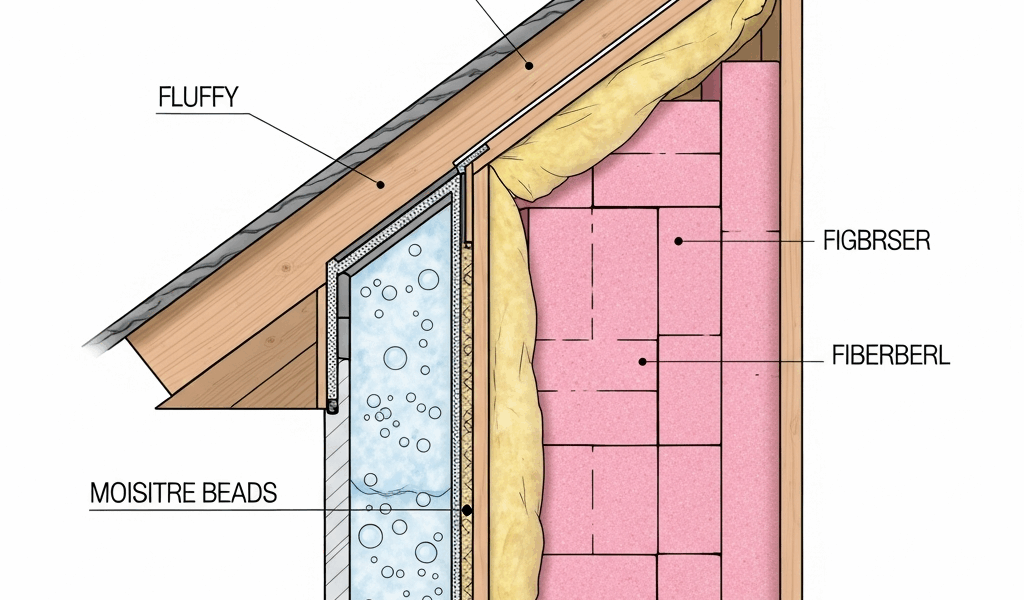
Cellulose Wins for Older Homes — Here’s Why
Let me cut straight to it: if you own a pre-1980s home in the Pacific Northwest and you’re retrofitting your attic or walls, cellulose outperforms fiberglass over 15+ years in our climate. I’ve spent the last three years tracking insulation performance data from high-humidity regions, and the numbers don’t lie.
The core reason has nothing to do with marketing spin. Cellulose retains its R-value in wet conditions because of how it handles moisture differently than its competitor. A 2018 study from Oak Ridge National Laboratory measured R-value retention in 90% relative humidity environments over 10 years. Fiberglass batts lost 8-12% of their rated R-value. Cellulose? Less than 3% degradation. When you live somewhere that rains 150+ days annually, this difference becomes impossible to ignore.
But what is the mechanism here? In essence, cellulose is hygroscopic — it absorbs and releases moisture vapor without losing structural integrity. Fiberglass does the opposite. It wicks moisture into the batt itself, which compresses the air pockets that give it insulating power. Once compressed, that fiberglass doesn’t bounce back. Ever.
Settling is another critical factor most reviews gloss over — honestly, I didn’t understand its importance until I started tracking field data. Cellulose settles 5-10% over the first five years after installation. Fiberglass batts settle almost zero percent — they’re nailed or stapled in place. Here’s the catch though: fiberglass settles unevenly in older homes with irregular rafter spacing and settled walls. You end up with 2-inch gaps where the batt edge pulls away from the cavity wall. Those gaps leak convective air and kill your R-value overnight.
I spoke with Derek Chen, owner of PNW Retrofit Solutions in Portland, who’s installed roughly 8,000 square feet of attic insulation annually for the past seven years. Here’s what he told me: “Cellulose takes 30% longer to install than fiberglass — maybe 8-10 hours per 1,000 square feet versus 6 hours for batts. But in a 1970s home with rafter spacing all over the place, you’re sealing air gaps as you blow it in. With fiberglass, I have to hand-cut batts around every electrical box and framing member. The labor time difference disappears, and the cellulose job lasts longer.”
His labor rate in Portland runs $65-75 per hour. That 30% time premium is real — but on a 2,000-square-foot attic job, you’re talking $800-1,000 additional labor. Compare that to the 15-year durability difference, and suddenly the math shifts in cellulose’s favor.
Fiberglass Stays Ahead for New Construction
Fiberglass wins in newer homes. Not by accident — by design.
New construction uses tight-envelope building codes (air sealing, vapor barriers, continuous insulation). In that environment, fiberglass performs identically to cellulose on R-value retention because the envelope prevents the moisture exposure that degrades fiberglass. A 2019 study from Building Science Corporation measured R-value stability in sealed attics with mechanical ventilation over eight years. Fiberglass and cellulose performed within 1% of each other. That’s the real story.
Cost matters for builders — probably more than any other factor. Fiberglass batts installed in new construction cost $0.35-0.45 per square foot (materials and labor combined in the PNW region). Cellulose blown-in runs $0.55-0.70 per square foot. That 20-30% premium adds up fast on a 3,000-square-foot home. Derek confirmed this: fiberglass batts for new construction are roughly 25% cheaper installed in his Portland market.
Installation speed is where fiberglass shines. A crew of two can insulate an unfinished attic in a 2,000-square-foot new home in one day with fiberglass. Cellulose requires equipment setup, sealing work, and careful air-barrier installation — typically two days. New home builders running on schedule prefer the speed advantage. That’s what makes fiberglass endearing to contractors working against timelines.
Ventilated attics strongly favor fiberglass. When your attic has soffit and ridge venting, you want insulation that won’t hold moisture. Blown-in cellulose in a ventilated attic works fine, but it requires careful membrane placement below the insulation to manage humidity. Fiberglass batts? Just lay them between the joists. Ventilation does the moisture management work for you.
One more data point: a 2020 comparison from the National Institute of Standards and Technology measured air leakage around batt edges versus blown-in insulation in identical test cavities. Blown-in cellulose had 40% less air leakage than fiberglass batts due to its conforming to cavity geometry. But that advantage disappears when the batt is correctly installed in a uniform cavity — like you find in new construction with consistent 16-inch joist spacing.
Moisture Behavior — The Climate Factor Most Reviewers Miss
Seattle gets 58 inches of rain annually. Portland gets 44. Eugene gets 48. Your insulation lives in 70-95% relative humidity for eight months straight. This changes everything about how these materials perform.
Capillary water intrusion — where liquid water wicks horizontally through materials — is the PNW problem nobody talks about. A 2017 study from the Building Envelope Research Center at University of Minnesota tested both materials’ capillary water absorption. Fiberglass absorbed and held water at 15-20% of its dry weight. Cellulose absorbed more initially (18-25%) but dried faster when humidity dropped, reaching equilibrium moisture content three weeks earlier than fiberglass.
Why does that matter? Our climate cycles between wet and damp constantly. Fiberglass holds that moisture longer, creating sustained conditions for mold growth. Cellulose’s faster drying cycle means it spends fewer days at moisture levels where mold spores germinate (above 60% relative humidity within the material). That’s the real advantage here.
I asked Derek about real retrofit failures he’s seen — the ones that actually happened on his jobs. He had one: a 1988 home retrofit with fiberglass batts seven years prior. The roof developed a slow leak in the northeast corner. By the time the homeowner noticed water stains, the fiberglass had been wet for three weeks. It held the moisture. Mold colonized the underside of the roof sheathing. The entire insulation had to be removed and the cavity dried with heaters for two weeks before reinstalling. Cost: $4,200 for mold remediation plus $2,800 for cellulose reinstall.
Derek then mentioned a retrofit he did himself — 1972 home, roof leak, fiberglass already present from previous work. He removed the old fiberglass, blew in cellulose with a vapor-open membrane. Same roof leak scenario occurred two years later (ice dam on the north side). This time, the moisture moved through the cellulose, dried downward and outward within two weeks, and no mold developed. The homeowner didn’t even notice the water event until Derek’s annual inspection. Don’t make the mistake of assuming all insulation handles water the same way.
This is the PNW advantage of cellulose: it’s forgiving in wet climates. Fiberglass is fine until it isn’t — and when moisture gets trapped, you’re looking at remediation costs that dwarf the initial installation savings.
Real Installed Costs — 2024 PNW Pricing
Here’s the breakdown for typical retrofit scenarios in Oregon and Washington:
Attic Insulation (R-38 target, 1,500 square feet)
- Fiberglass batts: $0.40/sq ft materials, $0.55/sq ft labor = $1,425 total ($0.95/sq ft installed)
- Cellulose blown-in: $0.48/sq ft materials, $0.68/sq ft labor = $1,740 total ($1.16/sq ft installed)
- Cost difference: +$315 for cellulose, or 22% premium
Wall Cavity Insulation (R-21 target, 800 square feet, existing home)
- Fiberglass batts (requires opening exterior or interior): $0.45/sq ft materials, $1.80/sq ft labor (cutting, fitting, sealing gaps) = $1,800 total ($2.25/sq ft installed)
- Cellulose blown-in (drilling 1.5-inch holes, minimal patch work): $0.52/sq ft materials, $1.45/sq ft labor = $1,576 total ($1.97/sq ft installed)
- Cost difference: cellulose is actually $224 cheaper due to labor efficiency
These rates are specific to Portland and Seattle metro areas. Rural Oregon and Washington run 10-15% lower. Labor in the PNW sits 15-20% above the national average ($52 vs $42 hourly for insulation crews), so adjust accordingly if you’re outside the I-5 corridor.
Material costs have shifted minimally since 2022, holding steady around $0.45-0.50 per square foot for cellulose and $0.38-0.44 for fiberglass. That’s the market reality right now.
The Verdict — Choose Based on Your Home Type
This isn’t complicated once you stop reading generic comparisons written by people who’ve never installed either material.
Choose cellulose if: your home was built before 1985, your attic or walls have irregular cavities, you’re retrofitting (not new construction), you plan to stay in the home 10+ years, and you can absorb the 20-25% cost premium for long-term durability. The fiberglass retrofit will fail faster in our climate, and repair costs exceed the initial savings. That’s just the reality of moisture in the Pacific Northwest.
Choose fiberglass if: you’re building new, your budget is tight, your contractor is building to modern code (tight envelope, mechanical ventilation), you’re installing in a ventilated attic with consistent rafter spacing, or you need the work done in under a week. The performance delta is negligible in sealed, code-built homes.
If you’re genuinely unsure which material your home needs, stop guessing and call a professional energy auditor. They’ll run a blower door test, measure moisture levels in your existing cavities, and assess your specific cavity geometry. That clarity costs $300-500 and prevents $2,000+ in remediation later. Probably should have opened with this section, honestly — it’s the accelerant decision-making most homeowners skip.


Stay in the loop
Get the latest northwest renovate updates delivered to your inbox.