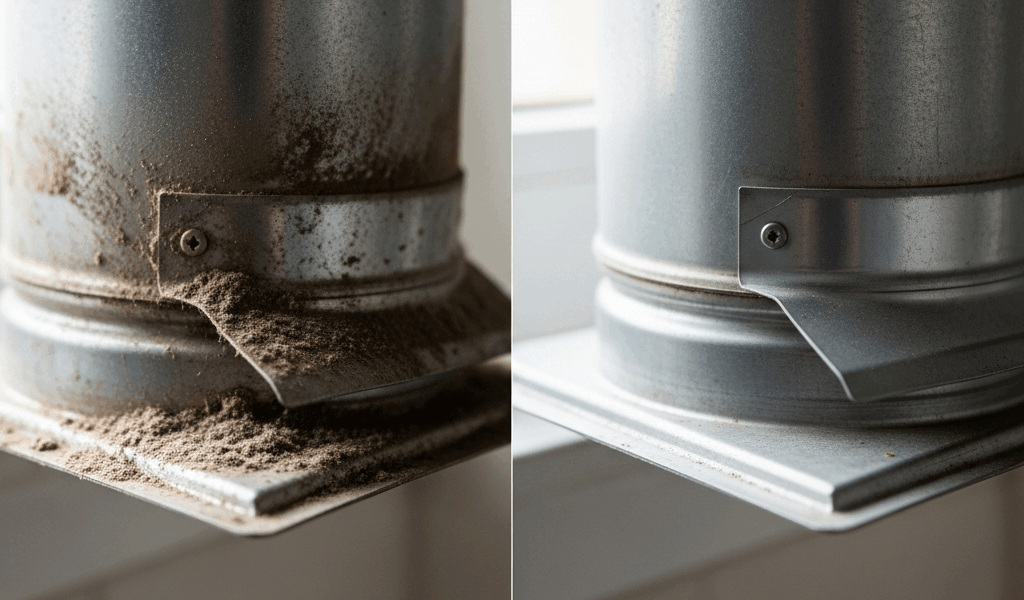
If a bathroom exhaust fan runs but is not pulling air, start with the grille and exterior outlet—not the wiring. A dirty grille, stuck damper, disconnected or crushed duct, excessive duct resistance, or a dirty blower wheel can all reduce airflow. If the fan hums without spinning, trips a breaker, smells burned, or shows heat or damaged wiring, switch it off and have a qualified electrician or HVAC technician inspect it.
A motor sound does not prove that moist air reaches outdoors. The U.S. EPA specifically recommends confirming that a bathroom fan exhausts sufficient air directly outside rather than into an attic or another enclosed space.
Bathroom fan runs but does not pull air: quick diagnosis
| What you observe | Likely area | Safe first action |
|---|---|---|
| Little suction at a dusty grille | Blocked intake or blower | Turn power off and clean removable parts according to the manual |
| Good suction at grille but little air outside | Duct or exterior damper | Inspect the accessible exterior hood while the fan runs |
| Air enters attic instead of outdoors | Disconnected or improper termination | Stop using it for moisture control and repair the duct route |
| Weak airflow with a long, kinked, or undersized duct | High static pressure | Compare the duct layout with the fan manual |
| Humming, no spinning, burning odor, heat, or breaker trip | Motor or electrical fault | Turn the circuit off; do not keep resetting or energizing it |
Step 1: confirm that the problem is airflow
Run the fan and hold a single sheet of toilet tissue against the grille. This is only a screening check: if the tissue will not stay against the grille, airflow is weak. A passing tissue test does not measure cubic feet per minute and cannot prove code compliance.
Also check what happens after a normal shower. Persistent mirror fog, condensation, or a musty odor can indicate inadequate ventilation, but those symptoms can also come from a long run time, an open bathroom door, high outdoor humidity, or another moisture source.
For an objective result, an HVAC or energy professional can measure delivered airflow at the grille. That matters because a fan’s label describes performance under specified test conditions; the installed duct system adds resistance.
Step 2: clean the grille and accessible blower area
Dust and lint narrow the grille openings and collect on the blower wheel. Before removing the grille, switch the fan off at the wall and circuit breaker and verify it cannot start. Follow the manufacturer’s instructions for that exact model.
- Remove the grille using its clips or fasteners without forcing it.
- Vacuum loose dust with a brush attachment.
- Wash only parts the manual identifies as washable, and dry them completely.
- Use a soft brush or vacuum on accessible blower blades; do not bend them.
- Reassemble the fan exactly as instructed, restore power, and repeat the airflow screen.
Do not spray lubricant or cleaner into the motor, capacitor, wiring compartment, or ceiling cavity. Do not reach into a powered fan.
Step 3: check the exterior termination
With the fan running, inspect an exterior wall termination from the ground. The damper or louvers should open and discharge air. Debris, nests, paint, corrosion, ice, or a damaged hood can restrict the outlet.
Do not climb onto a roof to inspect a roof cap unless you are trained and equipped for that work. A roof or high-wall termination can be checked by a roofing or HVAC professional. Dryer vents and plumbing vents are not substitutes for a dedicated bathroom exhaust termination.
If no exterior termination can be found, the duct may end in the attic or another concealed space. EPA guidance says bathroom exhaust should go directly outdoors, not into an attic or enclosed area. Correct that condition before relying on the fan to control moisture.
Step 4: inspect accessible ductwork
Only enter an attic that has safe access, stable walking surfaces, adequate clearance, and no exposed hazards. If the route requires stepping between joists, disturbing suspect insulation, approaching live wiring, or working near a roof opening, hire a professional.
Look for:
- a duct disconnected from the fan collar or exterior hood;
- flex duct crushed by stored items or insulation;
- sharp bends, loops, or long sagging sections;
- an incorrect duct diameter or reducer;
- loose joints or torn material;
- water collecting in low spots; and
- a termination into the attic rather than outdoors.
Compare the entire route with the fan manufacturer’s installation table. Allowable length depends on duct diameter, material, elbows, termination, and fan model; a generic “25-foot maximum” is not reliable for every installation.
If the duct has simply separated, follow the fan and duct manufacturers’ approved connection method. Do not assume ordinary cloth “duct tape,” zip ties, or a particular fastener is suitable. For a detailed symptom check, see our disconnected bathroom-fan duct guide, while observing the attic-safety limits above.
Why duct layout can make a good fan perform poorly
Every elbow, rough interior surface, constriction, and length of duct adds static pressure. ENERGY STAR’s ventilation-fan criteria include installed-performance testing at higher static pressure because a fan that delivers its label airflow in a low-resistance test can move substantially less air in a restrictive installation.
Common improvements include using the diameter specified by the fan manufacturer, shortening the route where practical, avoiding tight bends, supporting flex duct without crushing it, and using smoother duct where the approved design calls for it. Do not enlarge or reroute a duct through fire-rated construction without confirming code and firestopping requirements.
Step 5: decide whether the fan is undersized
Do not size a replacement from floor area alone without checking the locally adopted code and the room’s fixtures. Required intermittent or continuous airflow can differ, and large bathrooms or enclosed toilet/shower compartments may need additional capacity. Use the manufacturer or Home Ventilating Institute sizing guidance, then confirm local requirements.
Select a model whose certified performance includes the static pressure expected in the installed duct. A larger label CFM does not fix a blocked, disconnected, or severely restrictive duct. It can also add noise if installed in an unsuitable system.
When the motor or electrical system needs professional service
Stop troubleshooting and turn the circuit off if:
- the breaker or GFCI trips;
- the motor hums but the blower does not turn;
- there is a burning or hot-insulation odor;
- the housing becomes unusually hot;
- wiring, a connector, or insulation looks damaged;
- the fan sparks, stalls, or changes speed unpredictably; or
- water has entered the electrical housing.
Do not repeatedly reset a breaker, replace a capacitor, splice house wiring, or energize an open housing based on a generic article. A licensed electrician can isolate the circuit fault; an HVAC or ventilation professional can measure airflow and correct duct design. Some fan assemblies use a plug-in replacement module, but it must be the manufacturer-approved part for the exact housing and installed according to its instructions.
Repair or replace?
| Finding | Likely next step |
|---|---|
| Dirty grille or blower; normal operation after cleaning | Keep the fan and add cleaning to routine maintenance |
| Stuck or damaged exterior damper | Repair or replace the approved termination |
| Disconnected, crushed, or poorly routed duct | Correct the duct before replacing the fan |
| Clear duct but measured airflow remains low | Check installed performance, fan selection, and motor condition |
| Electrical fault, obsolete parts, or damaged housing | Have a qualified professional evaluate replacement |
Bottom line: clean the intake, confirm air actually exits outdoors, and inspect only safely accessible ductwork. Fixing the airflow path often matters more than buying a stronger fan. Treat humming, heat, odors, water intrusion, and breaker trips as electrical-service conditions—not DIY airflow tests.
Sources
- U.S. EPA: Remodeling Your Home and Indoor Air Quality
- U.S. EPA: Indoor Environmental Concerns During Remodeling
- ENERGY STAR: Ventilation Fan Key Product Criteria
- U.S. EPA: Controlling Moisture in the Home
Reviewed August 1, 2026. Product instructions and locally adopted codes control the installation.
Planning a remodel as well as diagnosing airflow? Coordinate the fan circuit and controls with our bathroom outlet height and receptacle-code guide before closing the walls.


Stay in the loop
Get the latest northwest renovate updates delivered to your inbox.