Why Your Shower Drain Smells Like Rotten Eggs
Shower drain smells have evolved with all the bad advice flying around. Half the internet tells you to dump bleach down there. The other half says baking soda fixes everything. I’ve dealt with this problem in three different houses — a 1970s ranch, a vacation cabin with seasonal plumbing, and my current place — and put in the work understanding that sulfur stench. Today, I will share it all with you.
There are actually three completely separate causes. Each one needs a different fix. Most homeowners try one random solution, fail, and give up. That’s the wrong approach — and honestly kind of an expensive one if you end up calling a plumber for something you could’ve handled with a kettle of hot water.
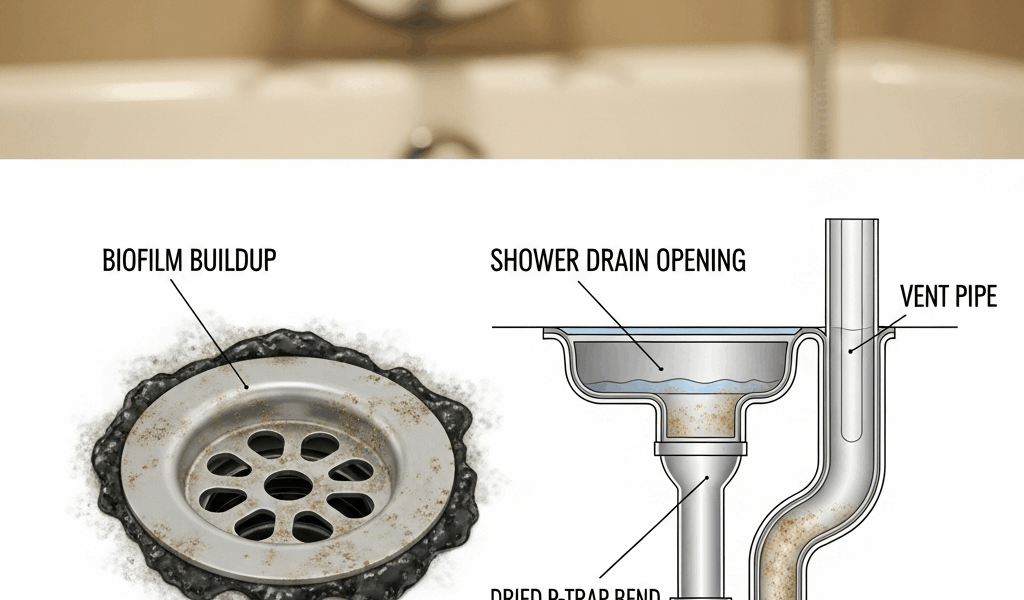
The piece that matters most here: the smell is either a dried-out P-trap, decomposing biofilm and hair, or a blocked vent pipe letting sewer gas crawl back up. Three causes. Three solutions. None of them overlap.
Here’s the fast way to figure out which one you’ve got. Shower sitting unused for weeks? P-trap. Use it daily but the smell just started recently? Biofilm. Smell gets worse right after someone flushes the toilet down the hall, or you hear gurgling? Venting problem. So, without further ado, let’s dive in.
Fix 1 — Refill a Dry P-Trap in Under 5 Minutes
But what is a P-trap? In essence, it’s that curved section of pipe directly beneath your drain — shaped like a U — that stays filled with water and physically blocks sewer gas from rising up. But it’s much more than that. It’s the entire reason your bathroom doesn’t permanently smell like a municipal sewer system.
When a shower sits unused — a guest bathroom, a vacation home, that second shower you keep meaning to use — the water in that curve evaporates. Slowly, quietly, over a few weeks. Once it’s gone, there’s nothing stopping the gas from coming straight up through the drain. That gas smells exactly like rotten eggs. Not similar to rotten eggs. Exactly like them.
The fix is almost embarrassingly simple. Run water down the drain for 30 seconds. Hot is fine — I usually just crank the shower on, let it run, done. That refills the trap. Wait a day or two and check whether the smell comes back.
If it returns within 72 hours, the trap likely has a slow seep somewhere — water’s escaping faster than it should. Flag it now. Don’t do what I did of just running water down it every few days for two months before admitting something was wrong. That’s a plumber call, not a DIY situation.
This is what I find in guest bathrooms and seasonal homes about 80% of the time. People open up a cabin after winter, get hit with that sulfur wall immediately, and assume the worst. Usually it’s just a dry trap. One water run and the problem disappears for another month.
Fix 2 — Clear Biofilm and Hair Buildup From the Drain
This is what happens in showers you actually use. That’s what makes drain biofilm so sneaky — it rewards regular shower use with a sewage smell.
Hair, skin cells, soap residue — it all collects down there. Bacteria move in and colonize the whole mess, forming a slimy layer called biofilm. As the bacteria break down hair and skin, they release hydrogen sulfide gas. Rotten eggs. Sulfur. Sometimes something closer to a backed-up septic system. You’re not imagining it. It’s real, it’s biological, and it’s genuinely unpleasant.
Start by pulling the drain cover — most just lift or unscrew — and grabbing visible hair with your fingers or a pair of needle-nose pliers. I keep a cheap pair, maybe $6 from a hardware store, specifically for this task. Get everything within reach. It’s unpleasant. Do it anyway.
Boil a full kettle of water and pour it slowly down the drain. This kills surface bacteria and loosens buildup. On its own, though, it won’t finish the job.
Follow that with roughly half a cup of baking soda, then white vinegar — pour it slowly so the foam doesn’t all bubble back up before it reaches the pipe. Let that sit for 30 minutes, then flush with more hot water. This chemical reaction helps break down the organic matter sitting in there.
If the smell is still hanging around after that, use an enzyme-based drain cleaner. I’m apparently particular about this — Green Gobbler works for me while Drano never actually solves the problem long-term. Here’s the real issue with caustic chemical cleaners: they kill bacteria temporarily, but the hair and organic matter feeding the bacteria is still sitting in your pipe. The bacteria come back within days. Enzyme cleaners actually digest the biofilm. They break down the food source. That’s why the smell stays gone for months instead of a week.
Pour the enzyme cleaner in, leave it overnight, flush it in the morning. Total active work time: maybe 25 minutes, spread across a day.
Fix 3 — What to Do If the Smell Keeps Coming Back
You’ve tried both fixes. The smell disappeared for a week, then came back. That’s a venting issue — and it’s a different beast entirely.
Your plumbing system has vent pipes running up through the roof. They let sewer gas escape outside and pull fresh air into the system so water drains correctly. When a vent stack gets partially blocked — leaves, bird nests, ice in winter, whatever — negative pressure builds inside the pipes. That pressure can actually pull sewer gas past your P-trap’s water seal. It essentially siphons the barrier dry from below. And then rotten eggs, again, everywhere.
The signs are pretty specific. Smell gets noticeably worse right after someone flushes a nearby toilet. Drain gurgles. Drains slowly even when there’s no visible clog. Sometimes you’ll hear a faint sucking sound as the water goes down.
This is not a DIY fix. Someone needs to get on your roof and inspect the vent caps. If the blockage is deep in the stack, you need professional equipment to clear it. Expect to pay somewhere between $150 and $400 — depending on blockage depth and your location. I paid $210 for mine in 2021. Worth every dollar compared to months of mystery smell.
One more thing worth checking: if the smell only comes from one bathroom while everything else seems fine, look at the wax ring on the nearest toilet. A failing wax ring leaks sewer gas directly into your walls. You’ll smell it through nearby drains. That was 1996 — well, 2019 in my case — and it took three weeks to figure out. Plumber territory, again.
How to Keep the Smell From Coming Back
While you won’t need a full plumbing overhaul, you will need a handful of simple habits. First, you should run boiling water down your shower drain once a month — at least if you want to avoid the whole cycle starting over. Two minutes. Keeps biofilm from establishing itself and keeps the P-trap healthy.
Install a hair catcher over the drain. A basic stainless steel one — I use a $9 model from Amazon, nothing fancy — catches most of what would otherwise accumulate in the pipe. Less organic matter down there means fewer bacteria. Simple math.
If you have a guest shower or secondary bathroom that doesn’t see regular use, run 30 seconds of water down the drain once a week. Put it on your phone as a recurring reminder. That’s a 30-second task preventing a two-hour problem.
An enzyme drain treatment quarterly is probably the single best preventive habit — at least if you want to avoid ever dealing with serious biofilm again. It breaks down buildup before it becomes a smell. Green Gobbler sells a maintenance formula that runs about $18 for a bottle that lasts a year of quarterly treatments. Much cheaper than reactively dealing with a fully clogged, fully odorous drain.
Here’s the honest reassurance: a rotten egg smell from your shower drain is fixable, common, and not a sign of anything catastrophic. It doesn’t mean your septic system is collapsing or your house has a structural problem. It’s plumbing maintenance. Nothing more, nothing less — and now you know exactly where to start.



Stay in the loop
Get the latest northwest renovate updates delivered to your inbox.