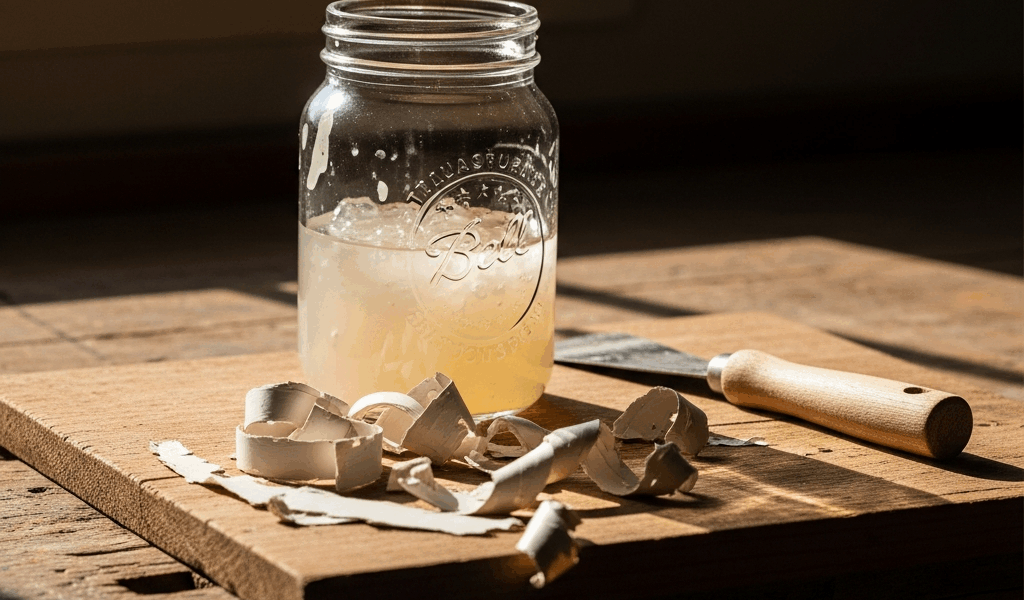
The best latex-paint remover depends on whether the paint is wet or cured and whether it is on wood, metal, masonry, glass, fabric, or drywall. There is no universally “non-toxic” stripper and no product that is safe on every surface. For many latex jobs, the safest effective sequence is warm water and detergent for fresh paint, gentle scraping for cured drips, and a label-approved consumer paint remover only after a hidden-area test.
For multi-layer, oil-paint, varnish, or mixed-coating projects, begin with our broader paint-stripper comparison by surface instead.
Before any removal, determine whether older coatings may contain lead. A modern latex topcoat over a pre-1978 layer does not make the underlying paint lead-free. Sanding, grinding, high-temperature heating, and aggressive scraping can spread contaminated dust and chips.
Latex paint removal: quick decision table
| Situation | Start with | Avoid |
|---|---|---|
| Fresh spill on a washable surface | Blot, then use water and mild detergent if the coating label allows | Rubbing the spill wider or adding strong solvent immediately |
| Cured drip on glass or durable metal | Label-compatible softening plus a scraper suited to the substrate | Scratching glass, damaging coatings, or using an unguarded blade |
| Latex on finished wood | Hidden test with the least aggressive compatible method | Assuming the remover will preserve stain, clear coat, veneer, or glue |
| Painted drywall | Repair, prime, and repaint when practical | Soaking or scraping through the paper face |
| Brick or masonry | Product specifically labeled for that masonry and coating | Uncontrolled high pressure, which can damage brick and mortar |
| Unknown coating in a pre-1978 building | Lead-safe assessment and containment | Dry sanding, grinding, torching, or uncontrolled heat |
First determine whether the paint is actually latex
“Latex” usually means a waterborne acrylic or vinyl-acrylic architectural coating, not natural latex. Once cured, it may resist water far better than a fresh spill. Old layers can include oil paint, varnish, shellac, lacquer, primer, or lead-based coatings beneath a water-based topcoat.
Check project records, original containers, and manufacturer information. If the finish is unknown, test removal in an inconspicuous area and evaluate every layer revealed. Do not infer chemistry from color, gloss, or age alone.
Fresh latex paint
Act before the film forms. Lift excess paint without spreading it, then follow the paint manufacturer’s cleanup directions. Water and mild detergent work for many fresh waterborne coatings on washable surfaces, but excess water can swell MDF, lift veneer, stain unfinished wood, damage drywall paper, or push paint deeper into fabric and carpet.
For upholstery and carpet, blot rather than scrub and follow the textile manufacturer’s care code. Test any cleaner for colorfastness. Large spills, delicate fibers, or valuable furnishings are better handled by a qualified cleaner.
Cured latex paint on wood
Start with a plastic scraper held at a low angle where it will not gouge the surface. A damp cloth may soften thin waterborne drips, but avoid saturating joints, veneer, MDF, and unfinished wood. If the paint is strongly bonded, choose a remover whose current label explicitly permits the coating and wood type.
A stripper can also soften the desired stain, clear coat, filler, adhesive, or surrounding paint. Masking does not guarantee chemical isolation. Test the entire process—including residue removal and drying—before treating a visible area.
Scrape with the grain using a non-damaging tool. Do not promise that one product will lift a specific percentage after a fixed dwell time; coating thickness, cure, temperature, wood porosity, prior finishes, and product formulation change the result. The product label controls application thickness, dwell time, reapplication, and cleanup.
Only after hazardous-coating concerns are resolved and the finish manufacturer permits mechanical preparation, use our best orbital-sander guide to match the pad, speed range, and dust connection to the substrate.
Metal, glass, and masonry
Metal
Bare metal tolerates some methods that painted, plated, galvanized, powder-coated, or anodized metal does not. Identify the base material and the finish you intend to preserve. Water and remover residue can promote corrosion, and aggressive wire wheels can remove protective coatings or throw particles. Follow the remover label and tool instructions.
Glass
Small cured spots may release with water, a compatible cleaner, or a purpose-made glass scraper. Keep the glass wet if the tool instructions call for it, use a fresh blade at a shallow angle, and avoid tempered-glass surfaces when the manufacturer prohibits blades. Protect frames, seals, tint films, and adjacent coatings.
Masonry
Porous brick and concrete can pull paint into pores. Use a system labeled for the specific masonry, paint, and indoor or outdoor setting. A poultice remover may help hold product against vertical or textured surfaces, but a mock-up area is essential. High-pressure washing can erode mortar, damage soft brick, drive water inward, and spread paint debris; “3,000 PSI” is not a universal recommendation.
Why drywall is different
Latex paint bonds to the paper face of drywall. Chemical stripping and prolonged wetting can delaminate or fuzz that paper, while aggressive scraping exposes gypsum. Unless there is a special restoration requirement, it is often better to remove loose material, feather damaged edges, seal torn paper with an appropriate problem-surface primer, repair, prime, and repaint.
If contamination or many unstable layers require full removal, replacing the affected drywall may produce a safer and more predictable result than saturating the wall with stripper.
Paint-stripper safety
Do not treat “citrus,” “soy,” “water-based,” “biochemical,” “low odor,” or “methylene-chloride-free” as synonyms for harmless. A product can irritate skin and eyes, release vapors, damage materials, burn, or require hazardous-waste handling even when its odor is mild.
The EPA prohibited consumer sales of methylene-chloride paint removers after acute fatalities. Do not use old stock. Methylene chloride may also be called dichloromethane or DCM. EPA has separately identified risks from N-methylpyrrolidone (NMP), so review the current label and Safety Data Sheet rather than assuming that a replacement solvent is safe.
PPE and ventilation
- Read the label and Safety Data Sheet before purchase and again before use.
- Use chemical splash goggles and any additional eye/face protection specified.
- Select gloves by the product’s chemical-resistance guidance; ordinary disposable nitrile is not universally protective.
- Provide the ventilation required by the label without creating an ignition source.
- Keep people, pets, food, flames, pilot lights, sparks, and smoking away.
- Do not rely on an N95 filtering facepiece for solvent vapors.
- Never mix removers or cleaners unless the manufacturers explicitly direct it.
If the label calls for respiratory protection, cartridge selection, fit testing, medical evaluation, change schedules, and workplace rules may apply. A box fan and an unspecified “respirator” are not a substitute for the controls defined by the product and hazard. For confined or poorly ventilated work, hire a qualified professional.
Lead paint changes the project
Assume a pre-1978 building may contain lead until reliable records or testing establish otherwise. A store test kit has limitations and is not the only evaluation method. Paid contractors disturbing paint in covered pre-1978 housing or child-occupied facilities must follow the EPA Renovation, Repair and Painting rule where it applies.
Do not combine a chemical stripper with a heat gun. Flammable vapors and softened chemicals can create additional hazards. For lead-painted surfaces, EPA lead-safe guidance prohibits open-flame burning and restricts high-temperature heat guns; dry power sanding, grinding, and abrasive blasting without required HEPA controls are also hazardous practices. Use current EPA lead-safe requirements, local rules, containment, HEPA cleanup, and appropriate disposal.
How to evaluate a consumer paint remover
- Match the coating: the label must cover the paint or finish being removed.
- Match the substrate: confirm wood species, masonry, metal finish, plastic, fiberglass, or other material.
- Read exclusions: many labels prohibit certain plastics, veneers, composites, or coatings.
- Check hazards: review signal words, ingredients disclosed, SDS, flammability, ventilation, PPE, and first aid.
- Plan cleanup: residue may require water, detergent, solvent, neutralization, or a manufacturer-specific after-wash.
- Plan disposal: removed coating can change the waste classification, especially when lead or other hazardous material is present.
- Test a small area: include the full dwell, scrape, wash, dry, and refinishing sequence.
Product formulations change. Do not rely on an old review’s claim about an active ingredient, odor, flammability, coverage, or dwell time. Download the current technical sheet and SDS for the exact product and region.
A safer step-by-step workflow
- Identify the building age, coating, substrate, and finish to preserve.
- Resolve lead and other hazardous-coating concerns.
- Choose the least aggressive viable method.
- Protect adjacent materials and establish containment.
- Set up label-compliant ventilation, PPE, and fire precautions.
- Test the full process in a hidden area.
- Work in manageable sections and do not exceed label dwell time.
- Collect wet residue and chips instead of spreading them.
- Clean or neutralize exactly as directed.
- Allow the substrate to dry and verify compatibility before refinishing.
Frequently asked questions
What removes dried latex paint?
Depending on the surface, dried latex may release through gentle scraping, a compatible cleaner, or a consumer remover labeled for cured water-based coatings. Test first; the strongest chemical is not automatically the best method.
Is citrus stripper safe indoors?
“Citrus” does not prove that indoor use is safe. Follow the current label and SDS for ventilation, ignition control, gloves, eye protection, and exposure limits.
Can I use a heat gun?
Only after excluding chemical-vapor and lead hazards and following the tool, coating, and substrate instructions. Never heat a surface treated with stripper, and do not improvise temperature advice for suspected lead paint.
Should I strip latex paint from drywall?
Usually not. Repairing, priming, and repainting—or replacing badly damaged drywall—is often more reliable than chemically stripping its paper surface.
Bottom line: for fresh latex, start with label-approved water cleanup. For cured paint, use gentle mechanical removal or a product specifically labeled for both the coating and substrate. Treat lead, ventilation, PPE, fire, residue, and disposal as part of the job—not afterthoughts.

Stay in the loop
Get the latest northwest renovate updates delivered to your inbox.