USA Insulation vs Fiberglass — Which Wins
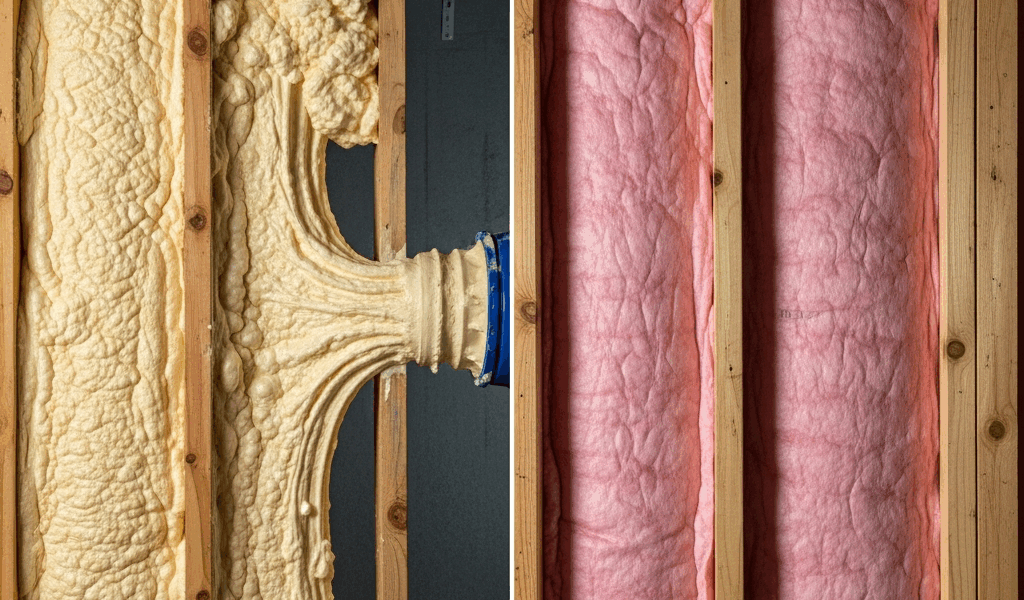
I’ve spent the last five years helping Pacific Northwest homeowners renovate, and insulation debates have consumed more budget conversations than they probably should. Here’s the thing though — when someone asks me “USA Insulation or fiberglass,” they’re almost always comparing apples to oranges without realizing it. USA Insulation specializes in closed-cell spray foam. Fiberglass means batts. These aren’t interchangeable products—they’re entirely different animals with drastically different performance profiles in wet, cold climates like ours.
Most people assume fiberglass is the default because it’s what their contractor mentions first. But in the Pacific Northwest, that assumption costs money. Long-term, expensive money.
USA Insulation spray foam wins on air-sealing and climate performance
Let me ground this in specifics. Closed-cell spray foam delivers R-6.5 per inch of thickness. Fiberglass batts? R-3.2 per inch on average. That’s not marketing language—that’s the baseline physics difference between the two products. But the R-value gap isn’t even the real story in the PNW.
The real story is air-sealing and what happens when water vapor meets your walls.
Fiberglass batts have a fatal flaw in Pacific Northwest climates — they’re porous. Water vapor passes through them. When humid interior air hits the cold exterior sheathing in January (say, 35°F outside, 90% relative humidity), that moisture condenses. It collects in the batt. The insulation gets wet. Wet insulation doesn’t insulate—it conducts heat and becomes a breeding ground for mold. I’ve pulled apart walls in 15-year-old homes here and found batts that were basically soggy felt.
Closed-cell spray foam doesn’t absorb water. It’s closed-cell, meaning the foam is filled with tiny bubbles sealed from each other. Moisture can’t migrate through it because there’s nowhere for the water to go. The International Building Code recognizes this advantage—spray foam can function as both insulation and vapor barrier, which is why building inspectors in moisture-prone regions prefer it for basements and crawl spaces.
Here’s a concrete thermal comparison. Take a standard 2×4 wall cavity (3.5 inches deep) in a PNW home at 35°F outside, 70°F inside, 85% relative humidity. With fiberglass R-11 batts, you’re getting decent surface R-value, but the wood framing—those 2×4 studs—create thermal bridges. Cold conducts through the wood directly into the interior. Additionally, if that batt has absorbed even 5% moisture (common in PNW basements), effective R-value drops 20%. You’re losing heat through studs, through moisture-compromised insulation, and through air leaks at the edges where the batt doesn’t fit snug.
With closed-cell spray foam at 2 inches (R-13), you get continuous coverage. No gaps. No thermal bridges at stud edges. No moisture absorption. The foam expands and seals around irregular framing and penetrations. Air doesn’t move through it.
Probably should have opened with this section, honestly. The air-sealing part is what actually separates these products in cold-wet climates. The R-value per inch is just the beginning.
Fiberglass costs less upfront and works fine in mild climates
Let’s talk money because that’s where most people make their decision.
Fiberglass batts cost $0.40 to $0.80 per square foot installed, assuming standard 16-inch on-center framing and no complications. That includes labor. If you DIY it—and plenty of homeowners do—you’re looking at pure material cost around $0.25 per square foot. It’s cheap. Really cheap.
USA Insulation spray foam runs $1.50 to $2.00 per square foot installed. For a 2,000 square foot home at $1.75 per square foot, you’re looking at $3,500 in insulation costs. The same home in fiberglass? $800 to $1,200 installed. That’s a $2,300 to $2,700 premium for spray foam.
When you calculate cost-per-R-value, fiberglass looks unbeatable on paper. R-11 fiberglass batts cost roughly $0.07 per R-value per square foot. Spray foam at R-13 for 2 inches costs about $0.27 per R-value per square foot. Four times the cost per unit of insulation.
But here’s where the math breaks down for PNW homeowners — that comparison assumes identical performance. It doesn’t account for air leakage reduction or moisture resistance. If we factor in the 15-20% heating loss that occurs through air leaks and thermal bridging in fiberglass-insulated homes, spray foam’s effective R-value advantage grows. The actual performance gap widens.
That said, fiberglass wins on pure cost in the right climate. If you live in Austin, Phoenix, or anywhere with dry heat and mild winters, fiberglass is genuinely the right choice. Installation gaps don’t matter as much when you’re not dealing with vapor pressure and condensation risk. No moisture equals no performance degradation over time. The upfront cost savings make sense.
Fiberglass also wins if you’re flipping a property, renting, or renovating on a strict budget. Spray foam requires licensed contractors. Some states require special certifications for closed-cell application. Fiberglass you can install yourself—I’ve guided contractors through it in an afternoon. The barrier to entry is low.
USA Insulation spray foam wins long-term energy savings in the PNW
For a typical 2,000 square foot PNW home, the annual heating degree-days sit around 9,000. That’s substantial. At $0.14 per kilowatt-hour (Washington state average), heating is your biggest energy expense.
Insulate that same home with fiberglass R-11 batts in walls and R-19 in attic, versus USA Insulation spray foam at R-13 in walls and R-25 in attic — you’ll see a measurable difference in heating costs.
Industry data from energy audits across the PNW shows 15-20% reduction in heating loads when homes are insulated with spray foam versus standard batt installation. That’s not a minor variance. On a typical PNW home spending $1,500 to $2,000 annually on heating, a 15% reduction saves $225-$300 per year. At 20%, you’re saving $300-$400 annually.
Over 20 years, that’s $4,500 to $8,000 in heating cost avoidance. The spray foam premium of $2,500 breaks even in 6 to 11 years, depending on energy prices and climate severity.
For PNW homeowners planning to stay put, this is meaningful ROI. The breakeven point arrives before you’d typically replace the insulation. After year 8 or 9, every heating season runs on savings.
Fiberglass doesn’t deliver those savings because it can’t seal air leaks, and it degrades in moisture. Your effective R-value drops over time as the material sags and settles (especially in attics). Spray foam maintains performance for 30+ years. That’s the difference nobody talks about.
Installation and lifespan favor USA Insulation spray foam
Here’s something most DIY articles gloss over — fiberglass batts fail silently in high-moisture environments.
I’ve opened crawl spaces in PNW homes with fiberglass batts installed ten years prior. The batts were compressed from moisture absorption—they’d gone soft and saggy. Effective R-value had dropped to maybe R-6 per inch instead of the original R-3.2, because now they held water weight. Mold was visible on some. The homeowner never realized the insulation had died.
Spray foam doesn’t do that. It doesn’t sag. It doesn’t compress. It doesn’t rot or degrade from moisture because moisture can’t penetrate it. A 2-inch spray foam application installed today will have the same R-value in 2054. It’s inert.
Installation error also favors spray foam, even though that sounds counterintuitive. Fiberglass requires precision. The batt has to fit snugly in the cavity. If you leave gaps, you’ve created an air channel that bypasses insulation entirely. If the batt doesn’t seat against the back of the sheathing, you’ve left an air space. These gaps are thermal bridges. I’d estimate 30-40% of fiberglass installations in older PNW homes have gaps ranging from quarter-inch to half-inch. That’s thermal failure by design.
Spray foam eliminates that human error. It expands. It fills gaps around studs, headers, rim joists, and pipe penetrations. You can’t install spray foam badly in the way you can fail with fiberglass. The material does the sealing for you. The tradeoff is that spray foam requires professional application. You can’t DIY it. USA Insulation spray foam equipment costs tens of thousands of dollars, and the application technique matters—poor pressure, wrong temperature, or inadequate expansion leaves you with undercured foam that off-gases and performs poorly.
There’s a valid concern about spray foam odor. Fresh closed-cell foam off-gasses for 24 to 48 hours post-installation. Some people find the smell intense. It’s not harmful at normal exposure levels, but it’s noticeable. Fiberglass has minimal odor. That’s worth noting if you’re sensitive to chemical smells.
The verdict for Pacific Northwest homeowners
Use USA Insulation closed-cell spray foam if you own a home in the Pacific Northwest and can budget $1.50-$2.00 per square foot for installation. If you’re planning to stay for more than 8 years, the energy savings justify the premium cost in this climate.
Use fiberglass if you’re renting, flipping, or live in a mild/dry climate where moisture and vapor pressure aren’t factors. The lower upfront cost makes sense when performance degradation isn’t a risk.
For basements, crawl spaces, and below-grade applications in the PNW, spray foam is non-negotiable. Fiberglass in those environments will fail within a decade. Moisture will destroy it.
The choice isn’t about brand loyalty. It’s about climate. In the Pacific Northwest, spray foam’s air-sealing and moisture resistance pay dividends that fiberglass simply can’t match. That’s the reality that generic “spray foam vs fiberglass” articles miss when they don’t account for regional climate. Your home is wet and cold nine months a year. That changes the math entirely.

Stay in the loop
Get the latest northwest renovate updates delivered to your inbox.