Why Kitchen Cabinets Warp in the Pacific Northwest
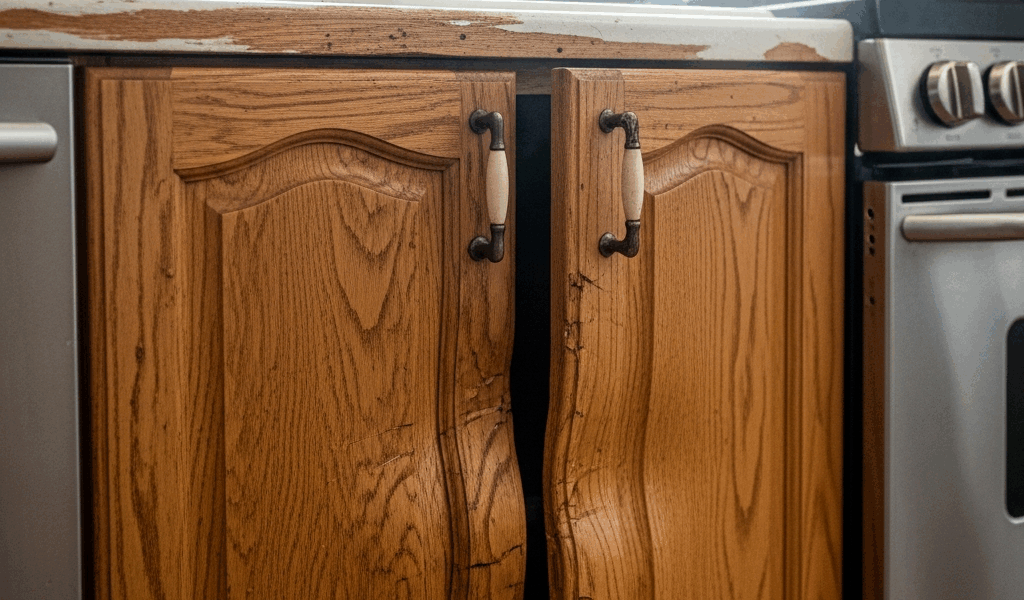
Kitchen cabinet doors warping from moisture — it’s the Pacific Northwest’s most persistent home maintenance headache. Living here, I’ve watched it happen to neighbors, friends, and honestly, my own kitchen. We’re basically asking wood to exist in a perpetually damp environment, and wood has other ideas.
Here’s the thing about wood: it’s hygroscopic. That means it absorbs and releases moisture based on whatever humidity levels surround it. When your kitchen experiences the PNW’s typical winter humidity (70–85% relative humidity) followed by occasional dry spells, the wood expands and contracts constantly. Solid wood cabinet doors respond dramatically to these swings. Veneer doors — which use a thin wood layer over plywood — handle humidity somewhat better. But they still warp when the substrate underneath moves.
The problem intensifies because our region maintains elevated baseline humidity year-round. Winter brings persistent moisture from rain and damp air. Summer, while drier, never fully dehumidifies — we’re talking 50–65% humidity on typical dry days. Most of the country gets true dry seasons. Here, we get “less wet seasons.”
Probably should have opened with this section, honestly. Understanding the mechanics matters because it explains why band-aid solutions fail in the Northwest. A cabinet door that warps in Arizona might be salvageable with a simple fix. In Seattle or Portland, the same door will warp again within months if you don’t address the underlying humidity.
When wood absorbs moisture, its cells swell. This happens unevenly across the door’s surface — the side exposed to more humid air swells faster than the sheltered side, creating curvature. Veneer doors fail differently. The substrate and veneer expand at different rates, causing the veneer to buckle or separate.
How to Identify Cabinet Door Warping Before It Worsens
Catching warping early matters. I made the mistake of ignoring subtle signs in my own kitchen for two years before the problem became expensive.
First, look at the door edges where hinges attach. Small gaps appearing between the door and frame indicate bowing. Stand at eye level and sight along the door’s surface — you’re looking for concave or convex curves. If light creeps under the door when closed, that’s evidence of warping.
The door-closing test takes thirty seconds. Open the door fully, then release it gently. Does it swing shut consistently, or does it stick at certain points? Warped doors develop tight spots that increase over time. Listen for rubbing sounds against the cabinet frame — that sound is your warning.
I recommend purchasing an inexpensive digital humidity meter. The kind costs $15–25 at hardware stores. AcuRite and ThermoPro models are reliable. Measure your kitchen’s relative humidity (RH) at different times. You want 30–50% RH for optimal wood stability. Above 60%, wood absorbs moisture. Below 25%, it dries excessively and cracks.
Document humidity patterns. Winter readings should prompt immediate action if they consistently exceed 70%. Summer baseline humidity above 55% suggests ventilation inadequacy.
Inspect door corners and joints while you’re at it. Solid wood shows separation at corners as it warps. Veneer doors develop visible lifting or peeling where the veneer meets the frame. These visual cues tell you warping has progressed beyond the reversible stage.
Quick Fixes for Minor Cabinet Door Warping
Minor warping — where doors still close and hinges sit flush — responds to simple adjustments.
Start with hinge adjustment. Most cabinet hinges have three adjustment screws. The vertical screw moves the door in and out. The horizontal screw shifts it side-to-side. The depth screw controls door positioning relative to the frame edge. Tightening or loosening these by quarter-turns often solves slight misalignment. Use a Phillips head screwdriver and adjust one screw at a time, testing the door fit between adjustments.
Shim placement works for bowed frames causing doors to misalign. Purchase composite shims (not wood — they’re more moisture-resistant) from any hardware store. Slide thin shims behind hinges on the hinge-side of the frame to push the door outward slightly. This compensates for frame bowing caused by moisture absorption.
Moisture barrier application prevents further warping. Here’s where most homeowners fail in the Pacific Northwest: they don’t address the root cause. Quick fixes work only if you simultaneously reduce kitchen humidity. Seal cabinet door edges and backs with exterior-grade silicone caulk. I use 100% silicone, not acrylic latex — brands like GE Silicone II cost $6–8 per tube and last longer. Apply a thin bead around all edges, especially the top and bottom of doors and along the back where doors contact the frame.
Weatherstripping adhesive-backed foam tape creates a moisture seal around door perimeters. This reduces air circulation that brings humidity into the cabinet cavity. Clean the frame surface completely before application. Remove any existing dried adhesive with rubbing alcohol. Apply new weatherstripping, pressing firmly into place.
Dehumidifiers matter more in the Pacific Northwest than anywhere else. For a kitchen, use a 50-pint dehumidifier during winter months (October through April). The “pint” rating refers to moisture removal per 24 hours. Frigidaire and Waykar models in the 50–70 pint range cost $200–350 and actually work. Place it in your kitchen or adjacent living space. Run it continuously during high-humidity seasons.
These solutions handle slight warping. Doors that close with minor friction or show small edge gaps fall into this category. But if doors no longer close, or if edges are visibly bowed more than a quarter-inch, you’re moving into permanent solution territory.
Permanent Solutions for Severe Warping
Severe warping requires accepting reality. The door is likely beyond repair in a wet climate.
Door replacement costs vary dramatically. Stock cabinet doors for standard sizes run $40–80 per door. Custom doors matching your cabinet’s finish cost $150–400. Professional cabinet refacing — replacing all doors while keeping the cabinet box — ranges from $3,000–8,000 for an average kitchen. Full cabinet replacement starts at $5,000 for basic cabinets and exceeds $15,000 for quality construction.
Before replacing, evaluate your cabinet box. If the frame itself shows signs of water damage (soft spots, separation at joints, visible rot), replacement is the only smart option. Damaged frames won’t support new doors properly.
When selecting replacement doors, choose materials suited to the Pacific Northwest. Plywood-based doors with moisture-resistant veneers outperform solid wood. Engineered doors with polymer coatings resist humidity swings better than traditional wood. Avoid particleboard in kitchens — moisture destroys it quickly. Hardwood plywood with UV-protective polyurethane finishes provides the best longevity.
Consider upgrading to hybrid cabinet materials. Some manufacturers now produce doors from waterproof composite materials that mimic wood appearance without the warping problems. Costs run 20–30% higher than traditional wood, but the durability in coastal and Puget Sound regions justifies the expense.
If your cabinet box is solid, refinishing warped doors sometimes works as an interim solution. Professional cabinet refinishing costs $800–2,000 and applies new finish coats to existing doors. This doesn’t fix warping but can extend the life of slightly warped doors by 2–4 years while you plan for replacement.
Preventing Future Warping in Humid Climates
Prevention requires behavioral changes and environmental management specific to the Pacific Northwest.
Ventilation is non-negotiable. Your range hood should vent outside — not recirculate air. Run it during and for 20 minutes after cooking. Winter cooking generates significant moisture. Many homeowners skip hood usage to avoid opening windows in cold weather. Mistake. That trapped moisture goes directly into cabinet wood. In winter, bathroom exhaust vents should discharge outside the house, never into attic spaces or vented into kitchen areas. I discovered my bathroom vent was redirecting moisture into my kitchen wall cavity. That fix alone reduced kitchen humidity by 8–12%.
Sealing and finish maintenance prevents moisture penetration. Annual inspection of cabinet finish — paint, stain, or polyurethane — should happen every spring. Look for cracks, peeling, or areas where raw wood shows. Touch up immediately. Consider applying additional protective coatings every 3–5 years. Spar urethane or exterior polyurethane provides superior moisture resistance compared to interior finishes.
Seasonal adjustments acknowledge PNW humidity patterns. Winter humidity peaks November through March. Increase dehumidifier runtime during this period. Open windows on rare dry days in January and February to exchange indoor air. In summer, reverse dehumidifier usage — you want less mechanical drying as outdoor humidity remains relatively high. This prevents over-drying and splitting.
Monitor humidity obsessively. Yes, obsessively. Place humidity meters in your kitchen and a secondary location. Track readings weekly. When humidity exceeds 65%, identify the source. Is cooking steam escaping through the range hood? Are windows condensating? Is the basement moisture migrating upward? Each source requires different solutions.
Install kitchen cabinet ventilation. Some cabinet manufacturers sell ventilation grilles that create airflow inside cabinet boxes, reducing pocket moisture. These cost $30–60 per unit and prove effective in high-humidity zones like the Pacific Northwest.
Here’s the thing: warped kitchen cabinet doors aren’t a sign of poor maintenance in the PNW. They’re a sign of living in an inherently humid region. Prevention beats repair every time. The homeowner who invests $300–500 annually in dehumidification, ventilation management, and finish maintenance never faces the $5,000–15,000 cabinet replacement bill. That math works everywhere, but it’s especially true west of the Cascades.
Before removing paint from a cabinet door, identify the substrate and finish using our latex paint remover guide by surface; moisture and strong chemicals can worsen veneer or MDF damage.
When damaged doors point toward broader cabinet replacement, start with the Seattle kitchen-renovation planning guide to coordinate layout, appliances, permits and comparable bids.

Stay in the loop
Get the latest northwest renovate updates delivered to your inbox.